The Big Idea
Chapters 4–6 gave you the connectionist (localizationist) models — language built up from discrete centres joined by connections. Chapter 7 is the first major alternative: the hierarchical models.
Connectionists: complex language is built up from simple, localised components. Hierarchical theorists: language and brain are arranged in successive levels, and higher levels superimpose upon, inhibit and modify the more primitive ones. Complex behaviour is a modulation of simpler behaviour, not an assembly of parts.
Superimposition — the organising principle
A more complex response partially inhibits and partially modifies a more primitive one. We modulate basic gait into running, climbing or dancing; we inhibit basic drives for social reasons; we adjust our reaction to danger using knowledge of how it might unfold. In neural terms, higher levels inhibit, release and modify lower levels.
This is unlike connectionism: although Wernicke's area influences Broca's area, that is not a higher-order modulation of Broca's intrinsic activity — it's just information arriving at a centre.
Because it is built on levels, the hierarchical approach has close ties — which connectionism lacks — to evolution (across species), development (in the child), and degeneration (in disease). Lower levels are evolutionarily older, appear earlier in the child, and are spared longest in slow disease.
"Holist" — where this sits in the book
Hierarchical models are one kind of holist theory — holists reject the idea of dedicated cortical centres for components of a language faculty, and favour unitary/integrated processes. The book examines three holist alternatives:
- Ch. 7 — Hierarchical: graded levels tied to evolution and development (this chapter).
- Ch. 8 — Global models: all aphasia traced to a single disturbed capacity (Marie, Goldstein).
- Ch. 9 — Process models: every task integrates many components, none doing a whole function.
The three figures of this chapter
| Theorist | Contribution | Hierarchy is in… | Anatomy? |
|---|---|---|---|
| Hughlings Jackson | The founder: levels of the nervous system; the proposition; negative/positive symptoms | the structure of the CNS | almost none |
| Roman Jakobson (1941) | The first truly linguistic study: phonological regression | the linguistic system (phonology) | none |
| Jason Brown (1980) | "Microgenesis": a detailed neuroanatomical hierarchy of processing stages | processing stages + CNS | heavy |
For connectionists, a deficit is a partial performance — the system minus a missing part (a Broca's aphasic = intact language minus speaking). For Jackson, the damaged brain acts as an integrated unit operating at a lower level: negative symptoms = what's lost (the damaged tissue), positive symptoms = the residual, more automatic behaviour produced by the intact lower levels that have been released from higher control. Open the Jackson tab for the details.
→ Work through Jackson, Jakobson, and Brown, then consolidate in the Cheatsheet and prove it in the Self-Test.
John Hughlings Jackson
The founder of the hierarchical approach — and a founder of clinical neurology itself. Founding editor of the journal Brain (where Lichtheim's paper appeared), he had debated Broca about aphasia back in 1866. He knew the connectionists' work, yet owed almost nothing to it: his account is, as Caplan says, "a product of his own genius."
Levels of the nervous system
Jackson saw the nervous system as a hierarchy of ascending levels, each more complex and more voluntary than the last. Higher levels superimpose on, and inhibit/modify, the lower.
| Level | Character | Examples |
|---|---|---|
| Lower | Automatic, involuntary, stimulus-bound; primitive structures. Present in the neonate; spared longest in slow degenerative disease. | Respiration, cardiac rhythm, endocrine function, sleep |
| Intermediate | Some independence from stimuli, but largely stereotyped once initiated. | Posture, gait, response to painful stimuli |
| Higher | Voluntary, not stimulus-bound, highly flexible. Depend on the most evolved cortex — the cerebral hemispheres. | Normal use of language |
Negative symptoms = the functions the patient cannot carry out → reflect the damaged tissue.
Positive symptoms = the patient's residual abilities → reflect the intact lower levels, now released from higher control and acting more automatically.
So the damaged brain doesn't run as "intact-minus-a-part" (the connectionist partial-performance view); it acts as an integrated unit operating at a lower level. The deep question both schools share: how does the intact brain reorganise after injury?
The proposition — Jackson's unit of language
Jackson denied the primacy of the individual word. The critical feature of language is the ability to form propositions — a proposition expresses a relationship between objects/events through the ordered juxtaposition of words. In "Gold is yellow," two names, by their grammatical arrangement, modify each other's meaning. We receive "not the words only, but the order of words also." A mere succession of names stirs up perceptions but conveys no thought.
(1) the structure of the proposition itself, or (2) the flexibility of its use. Either way, language shifts toward a more restricted, stereotyped, automatic mode. (Note this is strikingly modern — relations/grammar over the isolated word.) Word-sequences used in stereotyped, automatic ways are not true propositions.
The 1878 syndrome — "On affections of speech from disease of the brain"
Jackson described patients (a Broca's-like picture, though he didn't call it that) whose comprehension was fairly preserved but whose spontaneous speech was reduced to one or two words. Click each to reveal the detail:
Automatic words (e.g. oaths/obscenities) — uttered when upset, but also inappropriately. Stereotyped utterances — one or two words repeated constantly. Sometimes only ill-formed non-words remain (perhaps derived from words in the patient's mind at the moment of the lesion). None has the flexibility of propositional speech.
Only in limited situations: under emotion, on request, occasionally to a question. Under great emotional stress they may briefly manage more — famously, a carpenter, asked by his son where his tools were, produced the word "Master's." But they cannot use words to state relationships freed from the immediate situation — i.e. they cannot perform a propositional function. Producing automatic/stereotyped speech is itself an entire integrated function of a lower level.
Jackson treated them as elementary propositions — they assert or deny a relation. They are retained precisely because they are the simplest and most universal propositions.
These patients still understand what is said. So each word must be represented "in duplicate" — on a receptive level as well as an expressive level. They have lost expressive propositional speech but not the words themselves: speechless but not wordless.
Jackson assigned the receptive aspect of words and the more automatic use of language to the non-dominant hemisphere, and expressive, propositional language to the dominant one.
Strengths & weaknesses
| Strengths | Weaknesses |
|---|---|
| Emphasises the integrative nature of brain & behaviour. | Almost no anatomical basis (beyond the non-dominant-hemisphere hypothesis) — even less neural commitment than the connectionists. |
| The idea of higher-order modulation of primitive patterns. | Gives no account of the connectionist aphasic syndromes — no hint how those specific breakdown patterns arise. |
| Close ties to evolution & development (and degeneration). | Analysis is subtle but subjective (motives, situation) rather than a task checklist. |
Influenced Freud and Bastian; then largely neglected until Head (1926) revived it. Fused with gestalt/holist psychology, the hierarchical view went on to shape Goldstein (1948) — the global models of Chapter 8.
Roman Jakobson (1941)
His book on aphasia and child language is widely regarded as the first truly linguistic study of the aphasias. Working from case reports already in the literature (not his own data), he tied the pattern of language dissolution in aphasia to the pattern of language acquisition and to universal features of phonological structure.
What is a phoneme?
A phoneme is the minimal sound unit that can signal a difference in meaning. The p/t contrast distinguishes map from mat. By contrast, the extra puff of air (aspiration) on the p in pat vs tap is predictable and never changes meaning in English — so it is not phonemic.
For Jakobson, what matters about phonemes is their reliance on contrasts. And across the world's languages, these contrasts appear in a fixed hierarchy.
The hierarchy of contrasts
The most basic contrast is consonant vs vowel (closure vs openness of the vocal tract). The extreme members come first: the consonants p, t (and b) and the maximally open vowel a. From there:
- Consonants develop through place of articulation (labial → dental → palatal → velar → glottal), then nasality, degree of closure (stops before fricatives), and tongue position.
- Vowels develop through height, rounding, front/back position, and nasality.
A language has the rarer contrast only if it already has the commoner one. The guiding principle: maximal contrasts are used before minor ones (stops contrast with vowels more sharply than fricatives do, so stops come first). Break a law and the inventory is unstable — it tends to "repair" itself.
The key claim — phonological regression (the "mirror")
- Which phonemic inventories the world's languages possess.
- The order in which children acquire phonemes — an obligatory sequence, never a complex phoneme before its simpler prerequisites.
- The order in which aphasics lose them — the acquisition sequence run backwards. Complex phonemes go first; simple ones are retained; and recovery mirrors the order of acquisition.
This is the "regression hypothesis": last in, first out. It fits Jackson's view perfectly — in aphasia the simple, earlier structures are the ones retained.
Scope & limits
| Strength | Weakness |
|---|---|
| First rigorous linguistic account; gives concrete content to the idea of a hierarchy. | Restricted to the phonemic inventory. Caramazza & Zurif (1978) showed it does not extend straightforwardly to other levels of language. |
| Within phonology, the analysis appears valid. | Says nothing about the anatomical basis — like Jackson, it advances the linguistic question, not the neural one. |
Jason Brown (1980) — Microgenesis
A hierarchical model that, unlike Jackson's, draws heavily on neuroanatomy and makes specific claims about the neural basis of processing. It shares Jackson's evolutionary/developmental spirit, but its hierarchy is a different kind — a rapid sequence of processing stages realised in successive brain regions.
Producing or comprehending an utterance unfolds as a sequence of levels, from primitive → complex and from subcortical/limbic → neocortex. That sequence recapitulates evolution (phylogeny) and development (ontogeny) — but it happens in "micro"-time, in a fraction of a second, on every utterance. Both sequences begin in bilateral limbic structures (linking language to non-linguistic functions) and end in neocortex producing the formal linguistic code. In perception, the sequence runs in reverse.
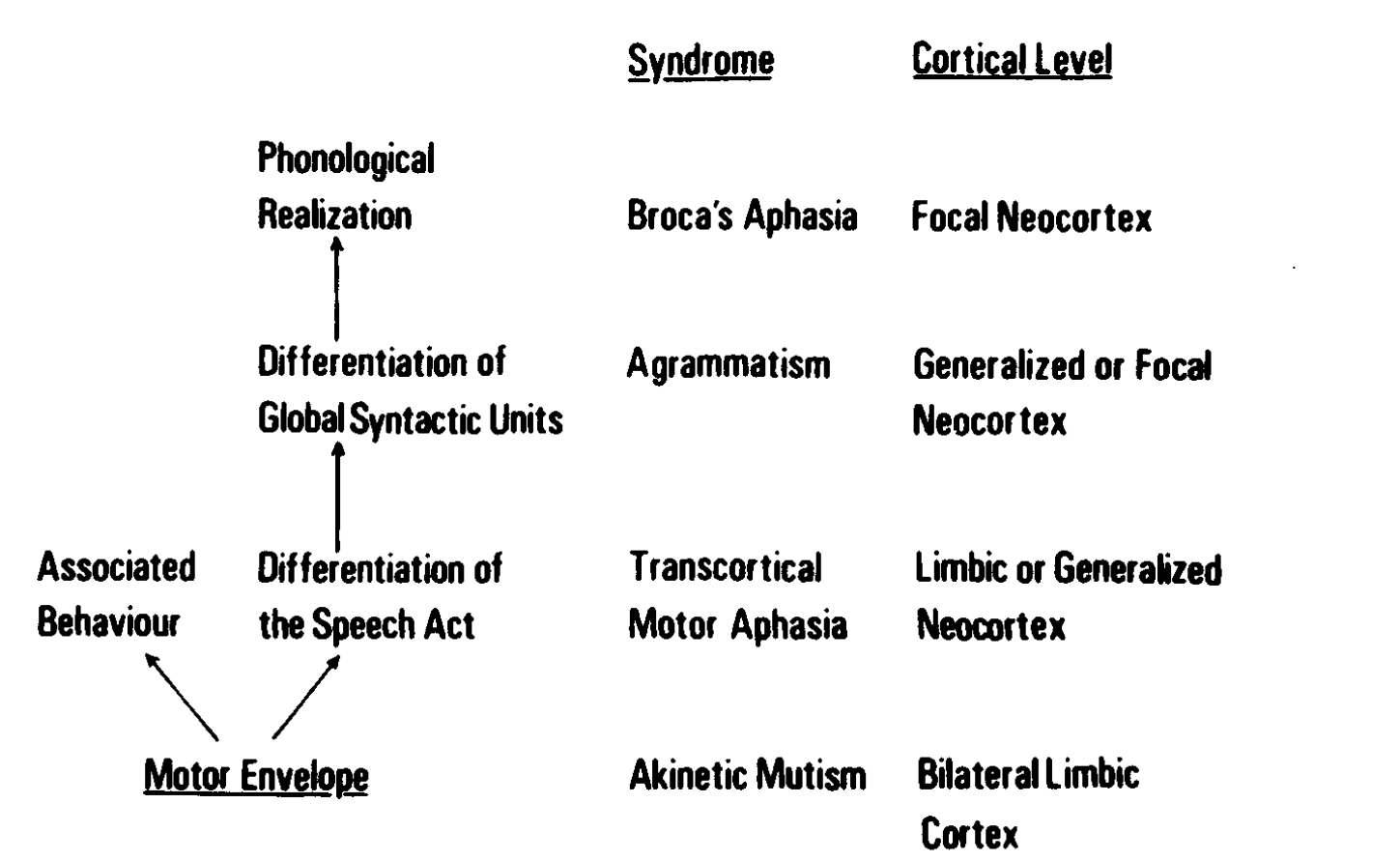
Anterior sequence — production (Fig 7-1)
Read the figure bottom → top (primitive → complex). Each level has a syndrome that appears if it's impaired, and a neural substrate. Click a level to study it:
Click a level above.
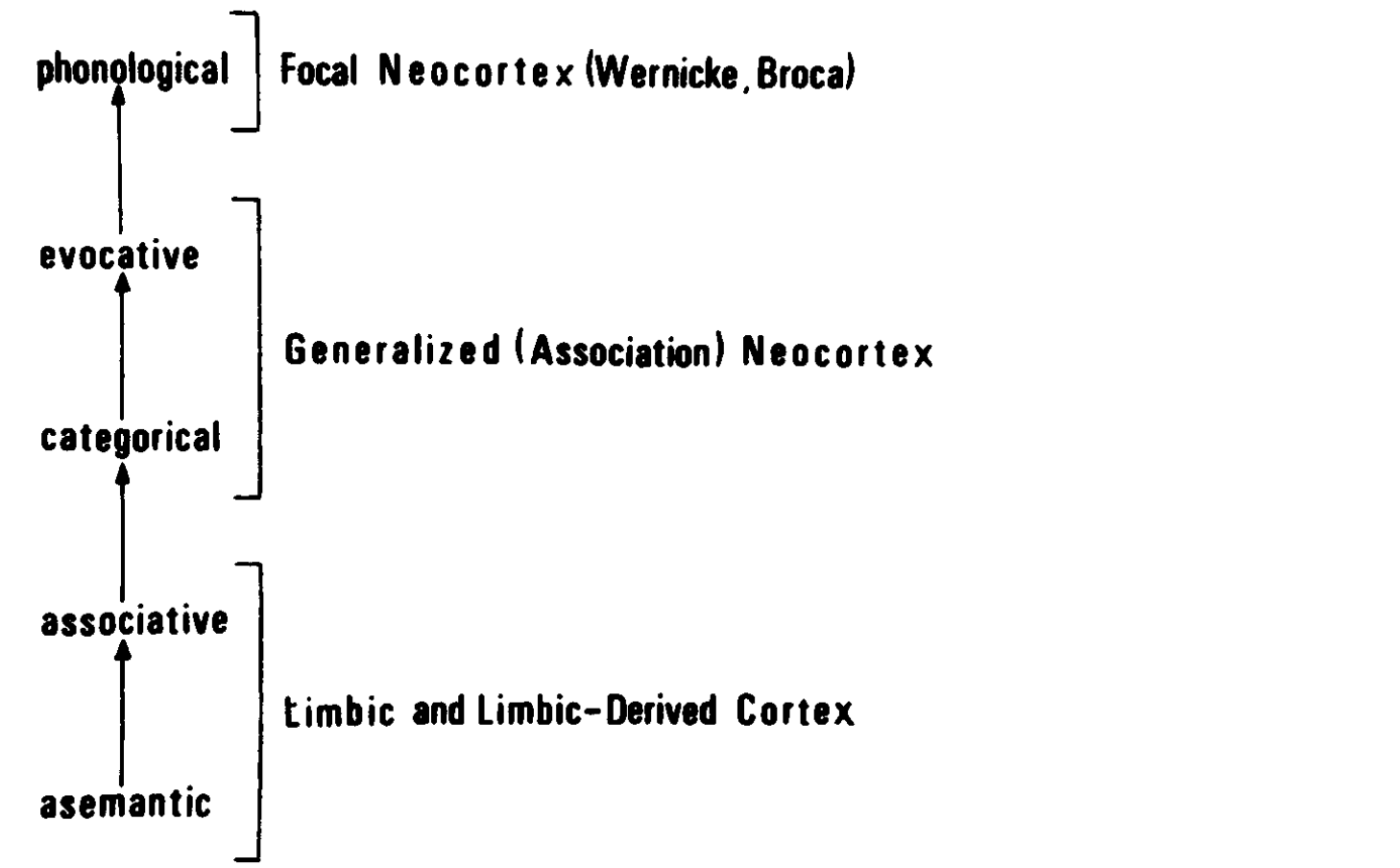
Posterior sequence — word selection / comprehension (Fig 7-2)
The posterior system selects lexical items, from a raw link with non-linguistic stimuli up to the phonological form. Errors at each level are a distinct paraphasia type. Click a level:
Click a level above.
The deepest posterior level is limbic — so its disorders are both aphasic and general behavioural. Brown links asemantic jargon to confabulation in Korsakoff's encephalopathy (a limbic amnestic syndrome): asemantic jargon is, in effect, a sub-type of confabulation. Just like akinetic mutism on the anterior side, these deep-level symptoms are not purely linguistic.
Ontogeny — the developmental evidence
The level–brain mapping shifts as the brain matures:
- Young child: a left frontal lesion → mutism, which can progress to agrammatism.
- Near puberty: the same lesion → phonemic/articulatory impairment with agrammatism.
- Adult: mutism needs comparatively deeper lesions; superficial lesions give only agrammatism/articulatory disturbance.
So an early focal cortical lesion produces the syndrome a deeper lesion produces in the adult — evidence that the processing sequence matures along the neuraxis.
Critique
| Worth keeping | Problems |
|---|---|
| Brings in factors connectionism ignored: psychological (automaticity, motivation) and neural (limbic structures). | May only extend connectionism, not refute it: restrict attention to focal language cortex and the two models look nearly identical. |
| Specific, testable-in-principle anatomical claims. | Vague terms ("categorical judgement", "motor envelope") — undefined, hard to compare across theories or to test. |
| Unifies ontogeny, processing, and breakdown. | Maybe not truly "hierarchical": the "motor envelope" (≈ intonation contour) may be complex, not simpler than syntax/phonology. And the anatomy is counter-intuitive (initiation moving from focal cortex to deep bilateral cortex with maturation). |
Cheatsheet
Everything condensed. Two ideas anchor the chapter: levels & superimposition (higher modulates lower), and the tie to evolution / development (lower = older = retained).
The three theorists
| Theorist | Hierarchy is in… | Key claim | Anatomy | Main weakness |
|---|---|---|---|---|
| Jackson (1874/78) | structure of the CNS | Levels superimpose; the proposition (not the word) is the unit; negative vs positive symptoms. | almost none | No anatomy; ignores connectionist syndromes. |
| Jakobson (1941) | the linguistic system (phonology) | Regression: one contrast-hierarchy governs language inventories, child acquisition, & aphasic loss (= acquisition reversed). | none | Phonology only (Caramazza & Zurif 1978); no anatomy. |
| Brown (1980) | processing stages + CNS | Microgenesis: each utterance unfolds limbic→neocortex in micro-time; levels map to syndromes. | heavy | Vague terms; maybe just extends connectionism; maybe not truly hierarchical. |
Connectionist vs Hierarchical (the cross-chapter contrast)
| — | Connectionist (Ch. 4–6) | Hierarchical (Ch. 7) |
|---|---|---|
| How complexity arises | built up by connecting simple components | higher levels modulate/inhibit lower ones |
| A symptom is… | a partial performance (system minus a part) | an integrated unit at a lower level (negative + positive) |
| Unit of language | the word (sound/written form/associations) | the proposition (Jackson); the phoneme contrast (Jakobson) |
| Ties to evolution/development | weak / absent | central |
| Camp | localizationist | holist |
Brown's two sequences (memorise the mappings)
| ANTERIOR — production (Fig 7-1), primitive → complex | ||
|---|---|---|
| Level | Syndrome | Cortical substrate |
| Motor envelope | Akinetic mutism | Bilateral limbic (cingulate) |
| Differentiation of the speech act | Transcortical motor aphasia can repeat | Limbic / generalized neocortex |
| Differentiation of global syntactic units | Agrammatism | Generalized / focal neocortex |
| Phonological realization | Broca's aphasia | Focal neocortex |
| POSTERIOR — word selection (Fig 7-2) | ||
|---|---|---|
| Level | Error type | Cortical substrate |
| asemantic / associative | asemantic / associative paraphasia (remote or no link); ≈ Korsakoff confabulation | Limbic & limbic-derived |
| categorical / evocative | semantic paraphasia ("table" for "chair") | Generalized association neocortex |
| phonological | phonemic paraphasia | Focal neocortex (Wernicke) |
Key terms
| Superimposition | A complex response partially inhibits + modifies a more primitive one; higher CNS levels inhibit/release/modify lower ones. |
| Negative symptoms | What the patient cannot do — reflects the damaged tissue. |
| Positive symptoms | Residual abilities — the intact lower levels, released from higher control. |
| Proposition | A relationship between objects/events via the ordered juxtaposition of words ("Gold is yellow"); Jackson's true unit of language. |
| "Speechless but not wordless" | Patients lose expressive propositional speech but still understand → each word is represented in duplicate (receptive + expressive). |
| Phoneme | Minimal sound unit that signals a meaning difference (p/t in map/mat). Defined by contrasts. |
| Implicational law | A language has a rarer contrast only if it has the commoner one; maximal contrasts come first. |
| Regression hypothesis | Aphasic phoneme loss = the child's acquisition order run backwards (last in, first out). |
| Microgenesis | The phylo-/ontogenetically ordered sequence of processing levels (limbic→neocortex), realised in micro-time on every utterance. |
| Akinetic mutism | Near-total absence of language within global inertia (not paralysed); bilateral limbic/cingulate; Brown's deepest anterior level. |
| Holist | Rejects dedicated cortical centres; favours unitary/integrated processes. Hierarchical, global, and process models are all holist. |
Names & dates
| Jackson 1866 / 1874 / 1878 | Debated Broca (1866); the proposition (1874); the "affections of speech" syndrome (1878). Founding editor of Brain. |
| Jakobson 1941 | First linguistic study of aphasia; phonological regression. |
| Head 1926 | Revived Jackson (and called undisciplined connectionism "chaos" in Ch. 4). |
| Caramazza & Zurif 1978 | Showed Jakobson's regression doesn't extend beyond phonology. |
| Brown 1980 / 1982 | Microgenetic theory. |
| Goldstein 1948 | Hierarchical + gestalt → the global models of Ch. 8. |
Active-Recall Self-Test
Don't re-read — retrieve. Answer each out loud (or on paper), then click to reveal. ★ = high-yield.