The Big Idea — language as a set of processes
Chapters 4–6 localised whole language faculties in separate centres; Chapter 7 posited a hierarchy of levels; Chapter 8 traced all aphasia to a single capacity. Chapter 9 takes a fourth path — and it is, in Caplan's words, "a partial return to connectionism."
A process model is built on a single insight: the usual functions of language — speech, comprehension, reading, writing — are not "simple entities" but processes that can be sub-divided into constituent parts. Every language activity is the result of several identifiable, localized processing sub-components, and it is those sub-components — not whole faculties — that are related to the brain.
What makes a model a "process model" — three changes
| Change | What it means |
|---|---|
| Qualitative, not quantitative | Connectionism leaned on a roughly quantitative comparison of how badly different tasks were impaired. That emphasis disappears completely; in its place is concern for the particular way a task is disturbed. |
| Many functions impaired at once | Because sub-components are shared between tasks, damage to one shows up across several tasks. So (esp. in Luria) language is usually impaired in a number of functions together — the system is interactive. |
| Sub-components, not faculties, mapped to the brain | "The faculty for articulate speech" is no longer a simple entity; it is a complex achievement built from many regions, each devoted to one small sub-component, each localized in its own area. |
Roots in — and departure from — connectionism
The seed was already in 19th-century connectionism: Wernicke and Lichtheim saw that the auditory word-forms in temporal cortex are conveyed to the frontal motor area — i.e. there are "different inputs into the motor planning of speech." But their processing analysis was thin: only a handful of operations, and some tasks (word recognition, done whole in Wernicke's area) had no internal components at all. Process models extend the processing account to every task.
Brown's microgenetic theory (Ch. 7) is the first example: it localizes the sub-components of production (motor envelope · differentiation of the speech act · of global syntactic units · phonological realization) and of the posterior word-selection sequence. There is no unitary "faculty for articulate speech" — only sequences of operations. Chapter 9's great exemplar, though, is A. R. Luria.
Where this chapter sits — the four approaches
| Chapters | Approach | Core idea |
|---|---|---|
| 4–6 | Connectionist | centres for whole functions, joined by connections (localizationist). |
| 7 | Hierarchical | successive levels of the nervous system; higher modulate lower. |
| 8 | Global / holist | one disturbed functional capacity behind all aphasic signs. |
| 9 (this) | Process | every function = many localized, shared processing sub-components. |
Process models keep the connectionists' localization but, like the other "psychological" models, care about the qualitative nature of breakdown. They are the last of the Part II "clinical" models — the bridge to the detailed psycholinguistic models of Part III.
→ Study Luria's Model and walk The Four Processes, drill the dissociations in Syndromes & Symptoms, consolidate in the Cheatsheet, and prove it in the Self-Test.
A. R. Luria — the first comprehensive process model
The Russian neuropsychologist A. R. Luria (Traumatic Aphasia, 1947; The Working Brain, 1973) produced "the first, most comprehensive, and most influential" neurolinguistic process model. His explicit aim: keep the best of connectionism (real localized components) and of holism (behaviour as integrated interaction).
The four defining features
| # | Feature | What it means |
|---|---|---|
| 1 | Comprehensive | Like Lichtheim's, the model covers the whole of language use — production, comprehension, reading, writing, repetition, naming — plus language's role in self-regulation and thinking. |
| 2 | Entirely modular | No function is a whole entity; each is built from sub-components, and the sub-components are frequently SHARED between tasks — so one lesion impairs more than one task. |
| 3 | Localized yet integrated | Each sub-component sits in a separate area; an entire function is the coordinated activity of many centres (the best of connectionism + holism). |
| 4 | Linguistic = non-linguistic | An area's psycholinguistic job is essentially the same operation it performs non-linguistically (clearest in the tertiary parietal/frontal and secondary association areas). |
One operation serves several tasks. Phonemic analysis (box E), for instance, is used in naming, repetition AND comprehension — so a single temporal lesion shows up in all three. This is the heart of the model, and the cleanest break from connectionism, where one lesion typically knocks out one faculty.
The whole device (Figures 9-5 & 9-6)
Luria's four task-models assemble into one language-processing device (Fig 9-5), mapped onto the brain (Fig 9-6). The components are labelled A–J. Click a component to study it:
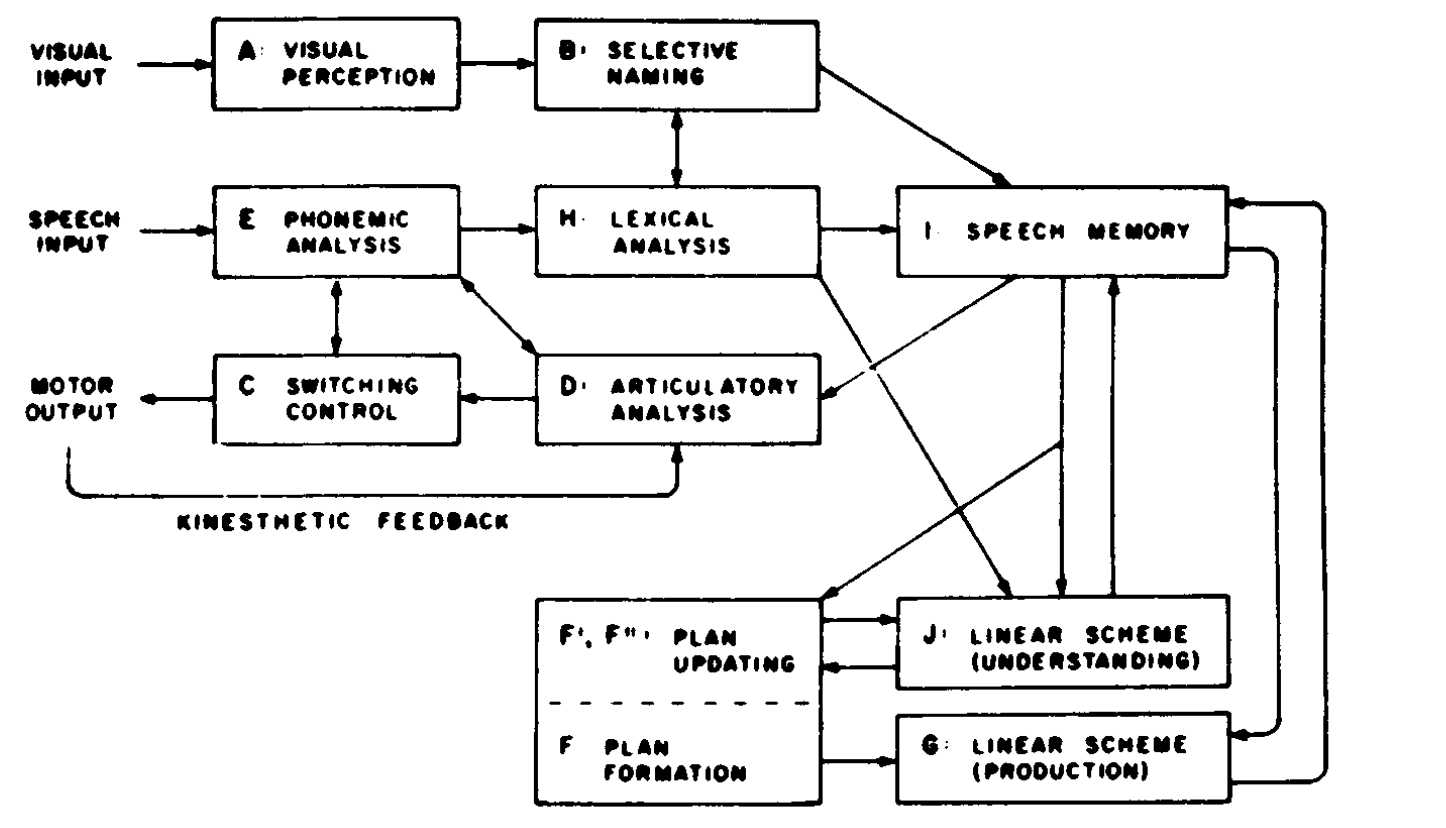
Click a component above to read its function, region and lesion-effect.
Fig 9-6 — the same components on the brain
Figure 9-6 places each lettered component on a lateral view of the left hemisphere. Click a region to see what it holds:
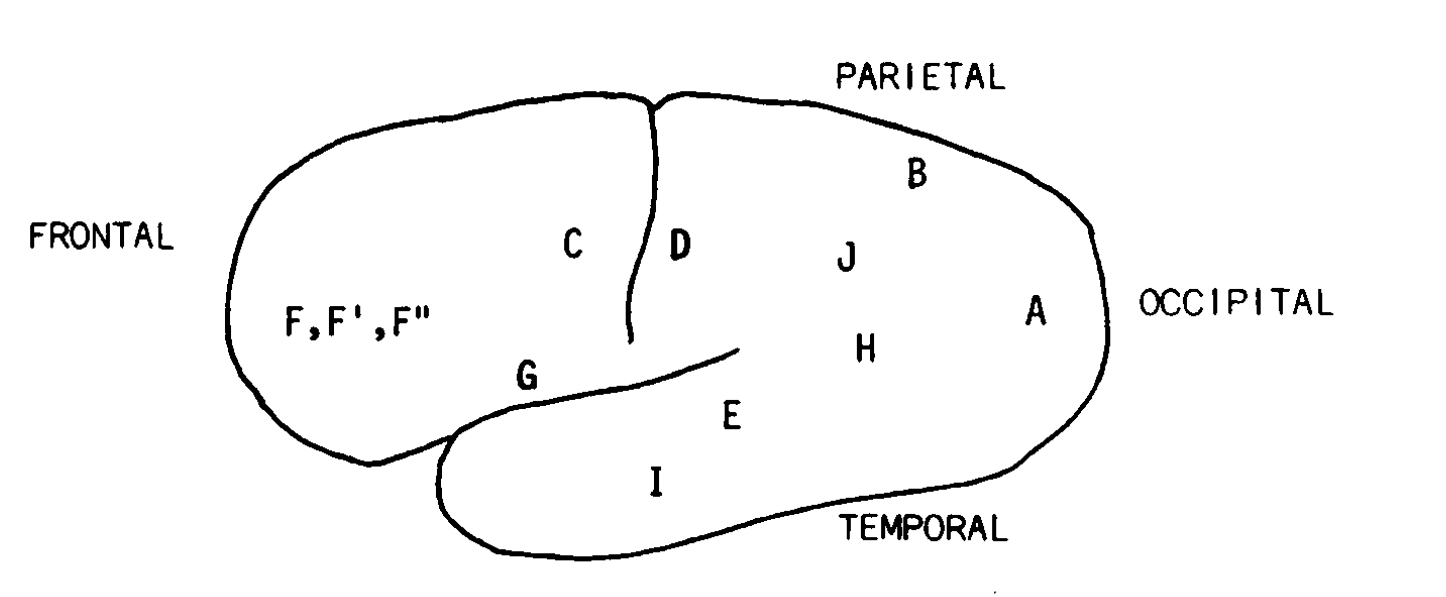
Click a region above.
Luria specifies the localization of each component — but NOT the localization of the connections between them. (Drop this line into any critique.)
Luria's wider theory
(a) Language and sensory-motor function
An area's sensory-motor function is tightly linked to its linguistic function — they are the same operation in different domains. Medial frontal lesions → akinetic mutism (no spontaneous activity, one act repeated for hours — the state Brown described in Ch. 7) and, in language, an inability to initiate conversation. Lateral pre-frontal lesions → movement becomes isolated gestures and, in language, efferent motor aphasia. This sharpens Wernicke's and Geschwind's point that association cortex serves language precisely because it sits next to primary sensory/motor cortex.
(b) Language in thinking and self-regulation
Language also facilitates abstract thinking, categorization and inference, and it regulates behaviour. Like Jackson and Goldstein, Luria saw behaviour as primitive actions governed by higher capacities; the primitive base was the Pavlovian conditioned reflex (Pavlov 1949), and as behaviour rises above instinct it comes under increasingly abstract capacities, in which language is critical.
The Four Processes
Luria works through each task as a chain of localized components. The figures are Arbib & Caplan's reconstructions. Click any box to read its function, region and lesion-effect.
1 · Speech production (Fig 9-1)
The skeleton is just two stages — plan, then linear scheme — but Luria's real account grades the deficit by lesion site, from the most general to the most narrowly linguistic.
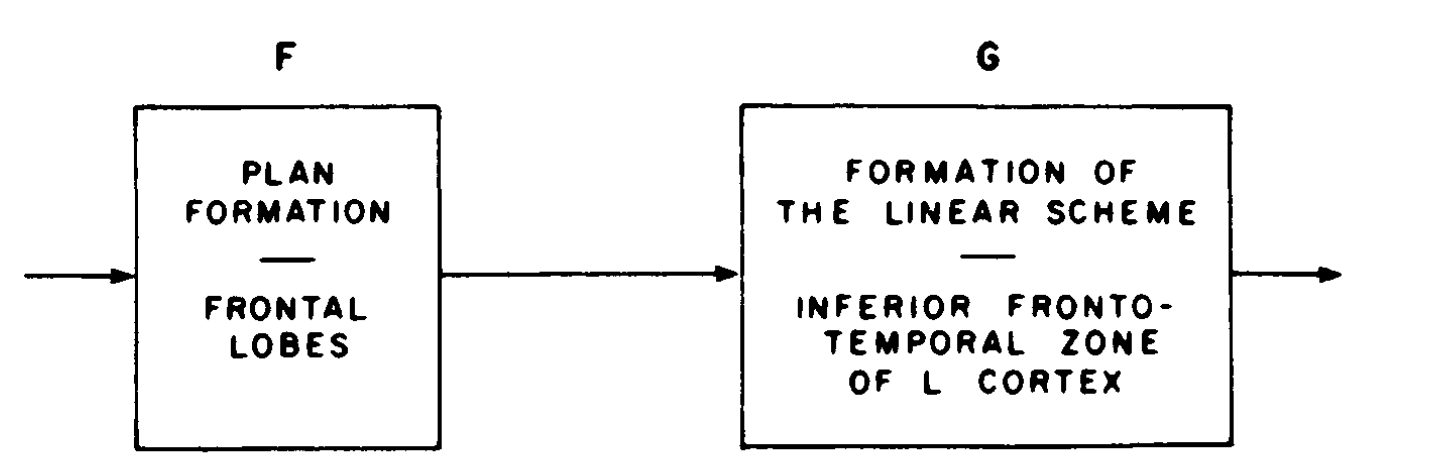
Click a box above.
The graded lesion story — click each to reveal:
A general loss of spontaneity/initiation: spontaneous speech is virtually absent; answers are passive, monotonous, sometimes echolalic. The patient easily answers "Were you drinking tea?" → "Yes, I was drinking tea" (question and answer are similar) but struggles with "Where have you been today?" (needs a different knowledge base/structure). Rooted in the frontal role in attention — Luria notes the best way to interview such a patient is sometimes to ask the question of a neighbour.
Resembles Lichtheim's transcortical motor aphasia: the patient can utter words and even repeat sentences, but is deprived of spontaneous speech. Luria traces it to the pre-frontal role in initiating movement — not to the disconnection of a concept centre from Broca's area. Stronger stimuli (repetition, naming) overcome the aspontaneity, and the linguistic form stays intact.
Governs the "smooth execution of complex serial movements." Lesions → perseveration, motor impersistence, failure to inhibit primitive reflexes (the glabellar/blink response). In language: halting speech in which the unit shrinks to the word or syllable; patients simplify expansive sentences; comprehension suffers (only isolated parts retained). A failure to link elements — not a true linguistic impairment.
Now language structures themselves disintegrate. The "dynamic schemata of words" break down: the unit of innervation becomes the single articulatory act, plasticity falls, switching from one articulation to the next becomes hard, and normal articulation becomes impossible; the "positional characteristics" that depend on neighbouring sounds are lost (writing may show perseveration of initial letters).
The temporal organisation of whole sentences runs through inner speech, which carries the "rudiments of the dynamic scheme of a sentence." When it is lost, so is the "dynamic unity of propositions": the word keeps its static, nominative (naming) function but loses its dynamic, predicative function. Object naming survives; conversational speech shrinks to the "kernel" — a few nominal phrases Luria calls the "serial naming of objects," or telegraphic style.
2 · Naming (Fig 9-2)
No acoustic model is given: the patient must look at an object and report his recognition with the right spoken word. This figure is the home of the chapter's signature dissociation — verbal vs literal paraphasia (boxes B vs E).
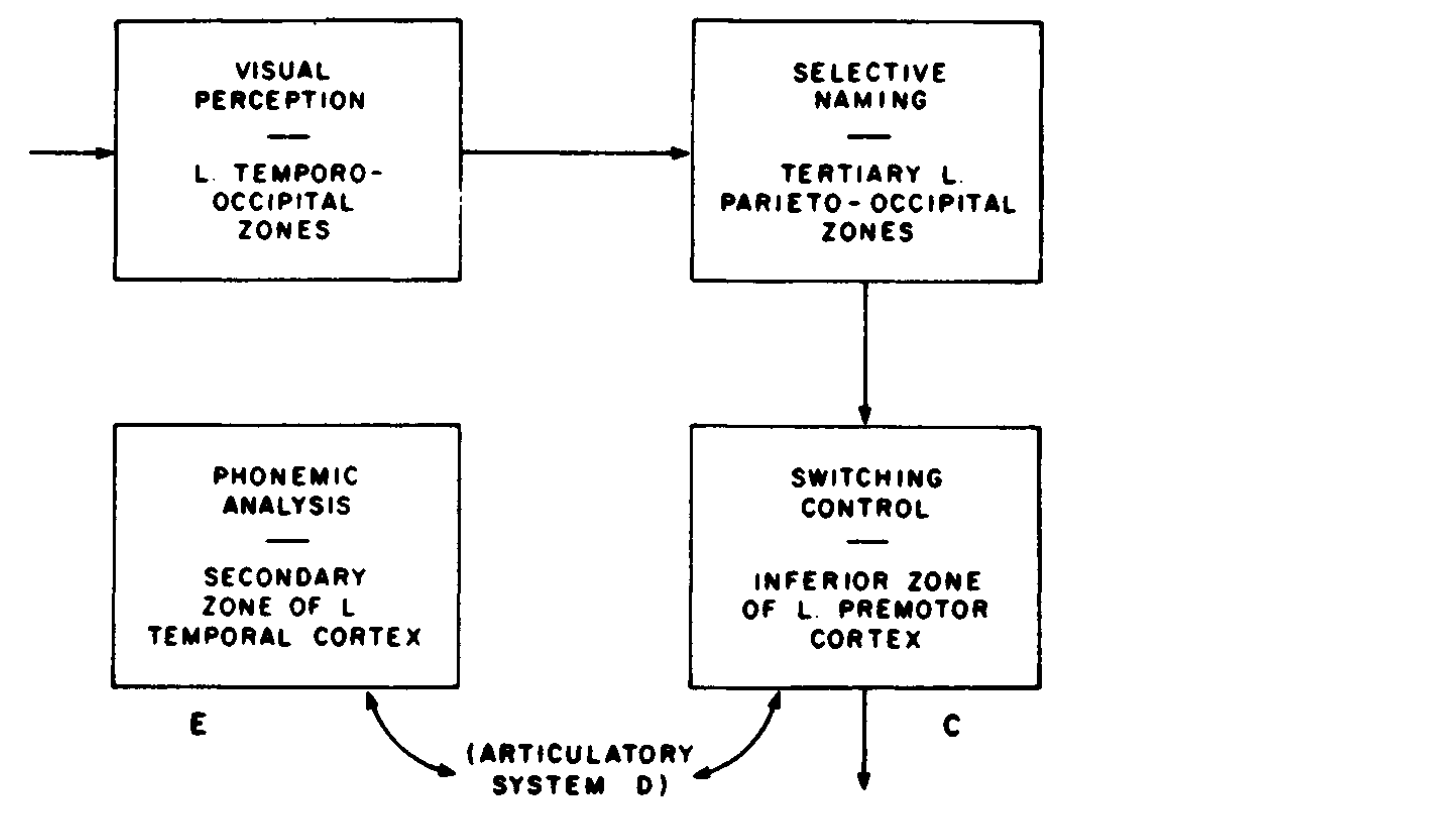
Click a box above.
3 · Repetition (Fig 9-3)
Repetition is a complex function needing several components — and it carries Luria's other great dissociation: afferent vs efferent motor aphasia (boxes D vs C).
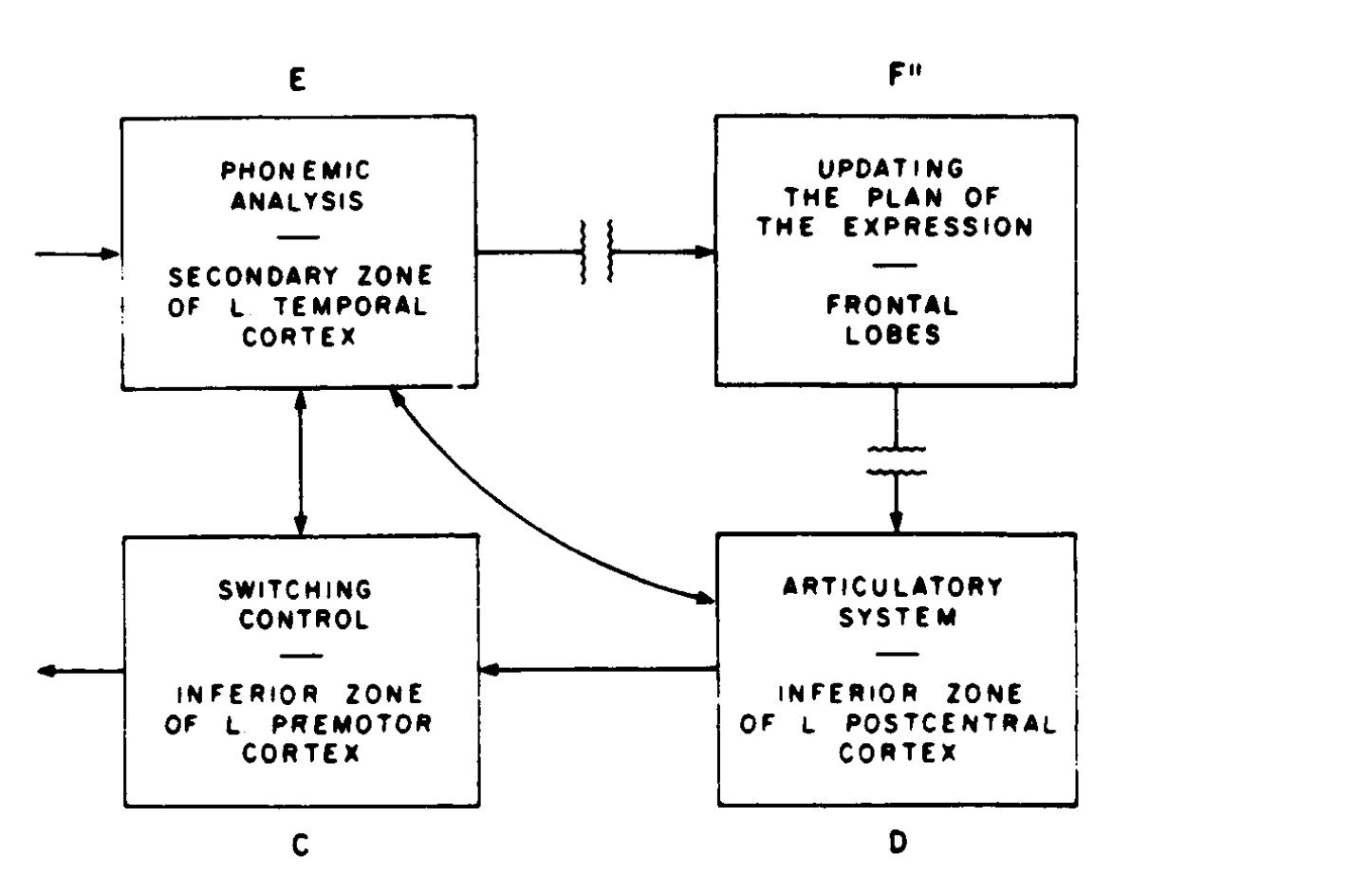
Click a box above.
4 · Auditory comprehension (Fig 9-4)
Comprehension begins, like repetition, with phonemic analysis (E) — whose failure Luria, following Wernicke, makes the basis of classical Wernicke's aphasia. Beyond the single word sit three sub-systems of "syntactic-semantic" analysis (I, J, F1).
![Luria's model of comprehension: E → H → [I, J, F1]](fig9-4.png)
Click a box above.
Every task is performed by several components in parallel and in sequence; many components serve several tasks (E appears in all three of naming, repetition and comprehension); and there is no mention of whole faculties anywhere. That is the process model in a single picture.
Syndromes & Symptoms
In Luria's model a syndrome is defined by which sub-component (and brain area) has failed. The same area recurs across tasks, so one lesion shows up in several. The last column gives the test that tells look-alikes apart.
The disorders at a glance
| Disorder | Site (box) | Mechanism | Hallmark & test |
|---|---|---|---|
| Adynamia | Medial frontal | loss of initiation / spontaneity | sparse, passive, echolalic speech; structure intact |
| Akinetic mutism | Medial frontal (severe) | no initiation of any activity | mute; repeats one act for hours; perseveration |
| Frontal dynamic aphasia | C area (inferior pre-frontal) | impaired initiation of speech (not concept-centre disconnection) | no spontaneous speech BUT repetition & naming intact (≈ transcortical motor aphasia) |
| Efferent motor aphasia | C inferior L premotor | loss of the "kinetic melody" / sequencing | isolated sounds OK, smooth polysyllables impossible; perseveration; writing-to-dictation defects |
| Afferent motor aphasia | D inferior L postcentral | loss of proprioceptive (kinesthetic) feedback | can't position tongue/lips; "articulemes" confused; dysarthric; writing errors |
| Acoustic agnosia | E secondary L temporal | failed acoustic discrimination of phonemes | can't tell apart 1-feature pairs (b–v, p–b); single-word comprehension fails |
| Acoustical-amnestic aphasia | I middle/deep L temporal | failed STORAGE of a verbal sequence (increased inhibition) | confuses order, recalls only first & last; spacing items out helps |
| Lexical / semantic disorder | H posterior L temporo-occipital | failed meaning access (auditory–visual analyzer) | phonemic analysis intact but words not understood |
| Logical-grammatical disorder | J L parieto-temporo-occipital jct | failed simultaneous synthesis of grammatical codes | fails syntactically loaded sentences; also spatial/arithmetic deficits |
| Verbal paraphasia | B tertiary L parieto-occipital | competitive-selection failure (inhibition removed) | whole-word error; first-sound prompt HELPS |
| Literal paraphasia | E secondary L temporal | phonemic-organization failure | within-word phoneme errors; first-sound prompt does NOT help |
| Telegraphic style | inferior motor / inner speech (G) | loss of the dynamic predicative function | output reduced to "kernel" nominal phrases ("serial naming of objects") |
Key dissociations — the exam gold
Verbal paraphasia → box B (selective naming, tertiary parieto-occipital): a whole-word error. A competitive-selection failure; the permanent representations are intact, so prompting with the first sound RESCUES the word.
Literal paraphasia → box E (phonemic analysis, secondary temporal): a within-word phoneme error. Here the first-sound prompt does NOT help.
Afferent → box D (inferior L postcentral): lost proprioceptive feedback → can't fix tongue/lip position → "articulemes" confused.
Efferent → box C (inferior L premotor): lost "kinetic melody" → isolated sounds fine, but smooth polysyllables impossible; perseveration.
| Dissociation | The distinction |
|---|---|
| Storage vs retrieval | I speech memory = storage (acoustical-amnestic) · tertiary parieto-occipital B = retrieval. |
| Phonemic vs lexical | E = can't hear/analyse the sounds (≈ Wernicke's) · H = hears them but accesses no meaning. |
| Initiation vs language proper | adynamia / frontal dynamic aphasia impair initiation but leave linguistic FORM intact. |
Which box serves which task (the shared components)
| Box | Component | Tasks it serves |
|---|---|---|
| A | Visual perception | naming (and reading) |
| B | Selective naming | naming |
| C | Switching control | production · naming · repetition |
| D | Articulatory analysis | repetition · articulation |
| E | Phonemic analysis | naming · repetition · comprehension (most shared) |
| F/F′/F″ | Plan formation & updating | all tasks |
| G | Linear scheme (production) | production |
| H | Lexical analysis | comprehension |
| I | Speech memory | comprehension · repetition |
| J | Logical scheme | comprehension |
Cheatsheet
Everything condensed. Anchor the chapter on two hooks: the shared sub-component (one lesion → several tasks) and the two signature dissociations (verbal vs literal paraphasia; afferent vs efferent motor aphasia).
Luria's four features
| 1 · Comprehensive | covers production, comprehension, reading, writing, repetition, naming + self-regulation/thinking (like Lichtheim). |
| 2 · Modular | every function built from sub-components, frequently shared → one lesion impairs several tasks. |
| 3 · Localized yet integrated | each sub-component in its own area; a whole function = coordinated activity of many centres. |
| 4 · Linguistic = non-linguistic | an area's psycholinguistic job is the same operation it performs non-linguistically. |
The components A–J (master table)
| Box | Component | Region | If damaged |
|---|---|---|---|
| A | Visual perception | L temporo-occipital | can't name / evoke a visual image; can't draw a named object but can copy line by line |
| B | Selective naming | tertiary L parieto-occipital | verbal paraphasia — first-sound prompt helps (a retrieval failure) |
| C | Switching control | inferior L premotor | perseveration; efferent motor aphasia (kinetic melody) |
| D | Articulatory analysis | inferior L postcentral | afferent motor aphasia (feedback); "articulemes" confused |
| E | Phonemic analysis | secondary L temporal | literal paraphasia / acoustic agnosia / ≈ Wernicke's — prompt does NOT help |
| F/F′/F″ | Plan formation & updating | frontal lobes | adynamia · frontal dynamic aphasia · repeats meaning · comprehension by guessing |
| G | Linear scheme (production) | inferior fronto-temporal | loss of the sentence's dynamic scheme → telegraphic style |
| H | Lexical analysis | posterior L temporo-occipital | phonemic analysis intact but meaning grossly disturbed |
| I | Speech memory | middle/deep L temporal | acoustical-amnestic aphasia (a storage deficit) |
| J | Logical scheme | L parieto-temporo-occipital jct | logical-grammatical relations fail (+ spatial/arithmetic) |
The four-way contrast — how each tradition explains symptom VARIETY
| Approach | Unit related to the brain | Source of symptom variety | Figures |
|---|---|---|---|
| Connectionist (4–6) | whole-function CENTRES + connections | WHICH centre or connection is damaged | Wernicke, Lichtheim |
| Hierarchical (7) | LEVELS of the nervous system | WHICH LEVEL is lost | Jackson, Jakobson, Brown |
| Global (8) | ONE general capacity | the degree/domain of impairment of that capacity | Marie, Goldstein |
| Process (9) | localized SUB-COMPONENTS | WHICH sub-component(s) fail — usually across several tasks | Luria (+ Brown) |
Connectionist vs Process — the high-value comparison
| Dimension | Connectionist (Wernicke, Lichtheim) | Process (Luria) |
|---|---|---|
| Unit → brain | whole-function CENTRES, joined by connections | localized processing SUB-COMPONENTS |
| Depth of processing | few operations; some tasks (word recognition) have NO internal components | every task decomposed into several components |
| Symptom variety from… | which centre / connection is damaged | which sub-component(s) fail |
| Emphasis | quantitative — relative impairment across tasks | qualitative — the WAY each task is disturbed |
| One lesion affects… | typically one task / faculty | several tasks at once (shared components) |
| Connections | explicit (centre-to-centre) | not specified — components localized, not their links |
Shared ground (state it first for top marks): both localize language sub-functions and relate symptoms to damaged components, not to one general capacity. Caplan's hook: process models are "a partial return to connectionism."
Strengths & limits
| Strengths | Limits |
|---|---|
| First reasonably detailed model tied to both aphasia and the brain. | Localizes the components but NOT the connections between them. |
| Captures qualitative, task-specific dissociations connectionism missed. | Processing vocabulary still coarse by later (Part III) standards. |
| Reconciles localization (connectionism) with integration (holism). | Heavy reliance on lesion data; some attributions tentative (e.g. lexical analysis via a "visual image"). |
| Shared sub-components explain why deficits co-occur; links language to sensory-motor function & the regulation of thought. | Box-and-arrow granularity is far simpler than real psycholinguistic processing. |
Names, dates & don't-confuse
| A. R. Luria 1947 / 1973 | Traumatic Aphasia (1947) & The Working Brain (1973); the first comprehensive process model. |
| Vygotsky 1939 | "inner speech" mediating thought → external speech; its loss → telegraphic output. |
| Pavlov 1949 | conditioned-reflex mechanisms = the primitive base regulated by higher (linguistic) capacities. |
| Arbib & Caplan 1979 | "Neurolinguistics must be computational" — source of Figs 9-1 to 9-5. |
| Roots / relations | Wernicke & Lichtheim (limited processing); Brown (microgenetic process model, Ch. 7); Jackson & Goldstein (behaviour regulated by higher functions); Geschwind (association cortex next to primary cortex). |
| don't confuse | "Broca's aphasia = Wernicke's aphasia + anarthria" is Pierre Marie (Ch. 8), NOT Luria. |
Process models treat the everyday functions of language as processes built from many small, localized, frequently shared sub-components — a partial return to connectionism that keeps the holists' stress on integration. A. R. Luria (1947; 1973) gave the first and fullest such model: comprehensive, entirely modular, localized-yet-integrated, and tying each area's linguistic job to its non-linguistic one. He analysed production, naming, repetition and comprehension as chains of components (A–J), mapped them onto the brain (Figs 9-5/9-6), and embedded the whole in a theory linking language to movement and to the regulation of thought. His qualitative dissociations — verbal vs literal paraphasia, afferent vs efferent motor aphasia, acoustical-amnestic aphasia — are the direct ancestors of the detailed psycholinguistic models of Part III. The lasting limit: he localizes the components but not the connections.
Active-Recall Self-Test
Don't re-read — retrieve. Answer each out loud (or on paper), then click to reveal. ★ = high-yield.