The word at the centre of language
"Lexical semantics" is the meaning of individual words. The word is what makes primary contact with the world — cat designates a kind of object, pull an action, large an attribute. This is the first chapter of Part III ("linguistic aphasiology"), and it pursues two questions in turn.
- What exactly is word meaning? → answered with philosophy (Frege, Putnam) and experimental psychology (Rosch).
- How does it break down after brain injury? → answered with the landmark patients of Warrington & Shallice and a running debate over how many "semantic systems" there really are.
How a lexical-semantic disturbance shows up
Two symptoms are expected: anomia (failure to name objects and pictures) and a single-word comprehension problem (failure to match a spoken word to an object).
Neither symptom proves a semantic deficit. You must first rule out problems producing or perceiving the sounds of words — a patient may fail to name or match simply because of a phonological problem, not a loss of meaning.
Three distinctions that organise the whole chapter
| Permanent vs access | is the permanent representation of a word's meaning lost, or is it intact but cannot be reached? (The access-vs-storage debate.) |
| Full vs partial | is meaning lost entirely, or only in part (e.g. superordinate category survives while subordinate detail is gone)? |
| Image-like vs abstract | is the retained meaning a visual image or an abstract linguistic representation? (Visual vs verbal semantics.) |
"Disturbances of lexical semantic representation" is a recurring direct question — set as 2023 Q4 and 2025 Q4. Anchor any answer on patient → claim pairings (Warrington → semantic memory; AR → access vs storage; JF/MP → optic aphasia; JBR/SBY → category-specific), and end with the single-system critique.
→ Start with Word Meaning, explore The Models (the 6 box-and-arrow diagrams), meet the Patients & Syndromes, consolidate in the Cheatsheet, and prove it in the Self-Test.
What is word meaning?
It seems obvious that a word means whatever it stands for — but the question is subtle. The consensus: a word's meaning is more than its reference.
Frege (1892) — reference vs meaning (sense)
The reference of a word is the actual item it designates; its meaning / sense is the way that designation is achieved.
Frege's example: "the evening star is the morning star" is a genuine astronomical discovery, whereas "the evening star is the evening star" is an empty tautology — yet both phrases refer to the same object, the planet Venus. They refer in different ways (the star seen in the evening vs the morning). So meaning ≠ reference: meaning reflects the way reference is secured.
Putnam (1973) — meaning as shared belief
What does "the way a word refers" amount to for a single word? Putnam pressed it with a thought experiment.
Imagine a planet just like Earth except that wherever we have aluminium, Twin-Earth has a different metal (molybdenum) with all the same observable properties — and its English-speakers happen to call that metal "aluminium." For the ordinary speaker the word means exactly the same on both planets, yet it refers to different substances. Conclusion: a word's meaning is the knowledge speakers share about its referents — "meaning ain't in the head."
Shared knowledge can be partial: we use gold correctly without knowing its chemistry or being able to tell it from "fool's gold" — it is enough to know gold is a valuable metal and that there exist experts who can settle hard cases (the division of linguistic labour). Part of the shared knowledge is a prototype — a representation of a typical referent (gold is gold-coloured; a lemon is yellow and lemon-shaped) — though the prototype is not the whole of meaning.
The classical theory held that each word stands for a concept with necessary and sufficient defining conditions. It is judged a failure — such conditions cannot be stated for most concepts. Putnam substitutes the looser idea of shared belief + prototype. (On this view the study of meaning becomes largely a part of psychology and sociology.)
Well-defined categories (numbers, letters, shapes, kinship terms, colours) have shared beliefs that can be stated rigorously. Ill-defined ones — biological kinds, and especially man-made categories (furniture, vehicles, tools — is a kitchen sink furniture?) — do not. Some words strain reference itself: unicorn (no real referent, only one in a "universe of discourse"), abstract words (faith), and function words (the, or — meaning without referring to entities).
Rosch — the psychology of meaning
Using priming (a related prime speeds the response to a target), Rosch found that for physically identical pairs the priming benefit was larger for prototypical members (fruit primed apple–apple more than nut–nut) → a word's meaning includes a representation of typical members. Priming was also faster for pictures than words → the representation may be more image-like.
Categories nest — a terrier is a dog is a mammal is an animal. One level, the basic-object level (apple, between superordinate fruit and subordinate Macintosh apple), is psychologically privileged: subjects list far more shared attributes and motor actions there, recognise it fastest, and acquire it first as children. (For biological kinds the superordinate behaves as the basic level.)
Prototype: the effect arose only for physically identical stimuli; Armstrong et al. (1983) found people will rate "better/worse" odd numbers — a strictly well-defined category — so prototype structure is sometimes imposed in a task rather than stored.
Hierarchy: it is not total — it takes longer to verify "dogs are mammals" than "dogs are animals," so the intermediate level does not always behave as intermediate.
Imagistic vs propositional code: Potter & Faulconer (1975) found a pictured apple is verified as "fruit" faster than the word apple → meaning may be image-like. But what single image does a superordinate like "fruit" evoke? A composite is hard to recognise, and meaning-as-image fails for abstract and function words — so meaning cannot simply be an image.
The Models — how many lexicons & semantic systems?
These are "information-processing" (box-and-arrow) models — boxes hold representations (word forms, meanings), arrows show what feeds what (like Wernicke/Lichtheim in Ch.4 and Luria in Ch.9). The key intermediate level between sensory analysis and meaning is the lexical representation (the form of a word). The six figures are a progression of competing answers. Click a model to study it:
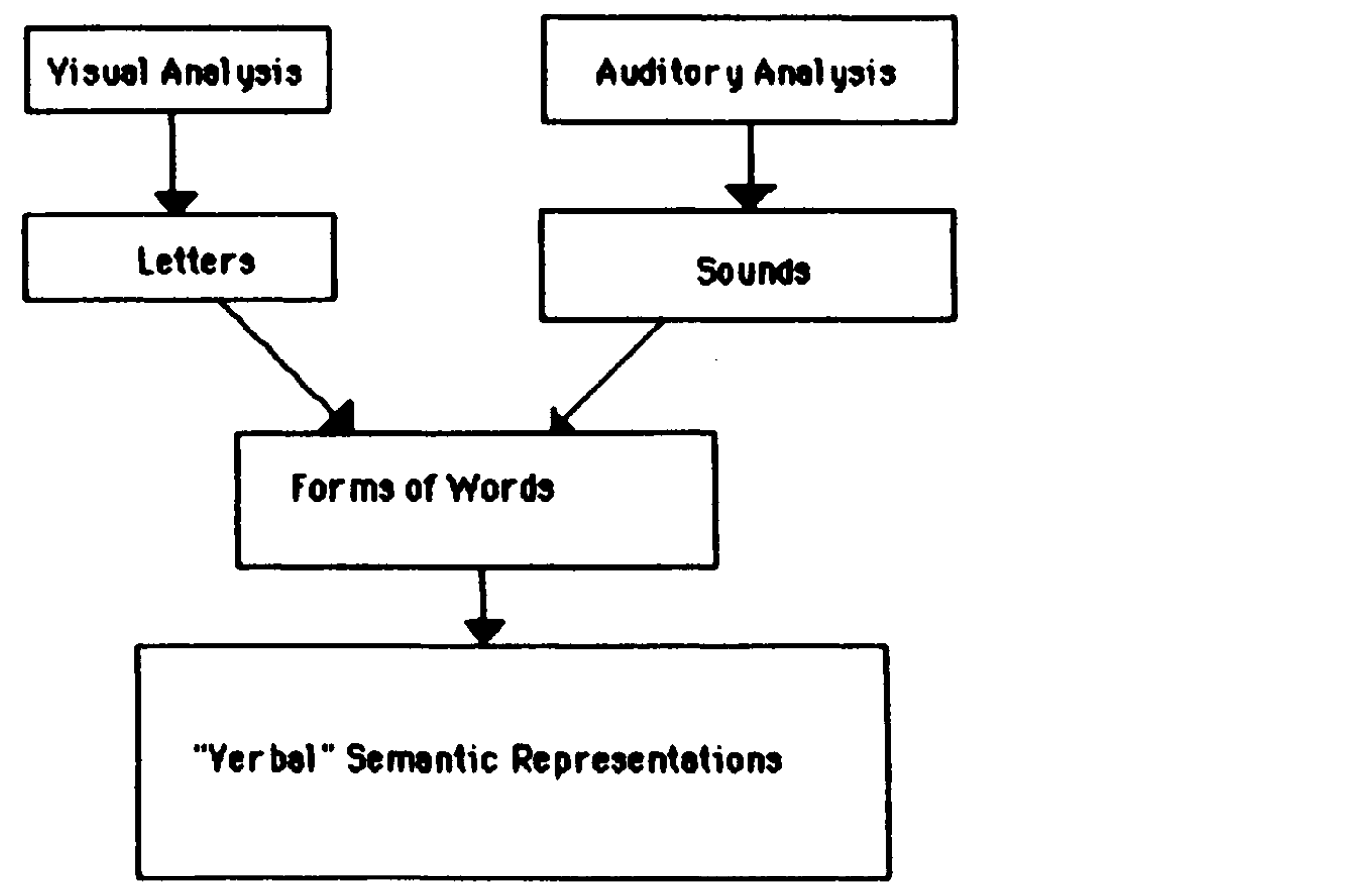
Click a model above.
The other Warrington & Shallice pillar — access vs storage
Alongside "how many systems," W&S asked whether a semantic disturbance is a loss of the permanent representation (storage) or a failure to reach it (access) — and proposed four criteria to tell them apart:
| Criterion | Storage / loss disorder | Access disorder |
|---|---|---|
| Word frequency | low-frequency words hit hardest | not frequency-sensitive |
| Consistency across trials | consistent — the same items fail | inconsistent — varies trial to trial |
| Superordinate information | selectively preserved | no selective preservation |
| Priming / cueing | does NOT help | helps — the representation is still there |
Superordinate survives subordinate → a storage loss. · A priming/cue that helps → an access problem (the representation must still be there). Priming is the strongest of the four criteria; frequency & consistency are the shakiest (see the critique in Patients & Syndromes).
Patients & Syndromes
The disorders half is built on a cast of patients, each paired with a theoretical claim — the structure that scores in an exam. Click a patient to study the case:
Click a patient on the left.
The critique — is one semantic system enough?
The celebrated EM/AB double dissociation is weak: both patients were actually better with pictures overall and impaired on both words and pictures. And some "semantic" successes may rest on non-semantic information — the look of a picture, or word-to-word associations (e.g. answering "is it English?").
Their alternative keeps a single semantic system but adds a stage of structural descriptions (shape representations) on the visual route, with cascade dynamics — enough to explain optic aphasia and JB without multiplying stores. (See models 12-5 and 12-6.)
Milberg & Blumstein (1981) showed priming (criterion 1) is informative but subtle. The frequency and consistency criteria rest on a simplistic neural assumption (why should connections, but not stores, be frequency- and time-sensitive?), and even the prized superordinate-preservation criterion is just one of many patterns of partial loss (Goodglass & Baker 1976). Caplan's verdict: the framework is invaluable as a way to pose questions, even if the fine detail is doubtful — and it is premature to treat any dividing line as final.
Cheatsheet
Everything condensed. Lead with what meaning is (Frege + Putnam), then the patients, then the access/storage table and the one-system critique.
What word meaning is
| Frege (1892) | reference (the item) vs meaning/sense (the way it's designated). Evening star / morning star both = Venus, different senses. |
| Putnam (1973) | meaning = shared belief about referents (Twin-Earth; "meaning ain't in the head"); division of linguistic labour (gold/experts); prototype; vs the failed classical (Aristotelian) theory. |
| Rosch (1975, 1976) | prototypicality (priming; pictures > words); the privileged basic-object level in a conceptual hierarchy. Caveats: Armstrong et al. (imposed prototypes); "dogs are mammals" slower than "dogs are animals." |
Access vs storage — the four criteria
| Criterion | Storage / loss | Access |
|---|---|---|
| Word frequency | low-frequency hit hardest | not frequency-sensitive |
| Consistency | consistent (same items fail) | inconsistent (varies trial to trial) |
| Superordinate info | preserved | not selectively preserved |
| Priming / cueing | does not help | helps |
The rival models (how many lexicons / semantic systems?)
| Model | Lexicons | Semantic systems | Claim / motivation |
|---|---|---|---|
| 12-1 | one | one | single word-form store + single meaning store (AR rules this OUT) |
| 12-2 | two (written, auditory) | one (shared) | separate input routes to one meaning store (compatible with AR) |
| 12-3 | two | two ("written", "auditory") | meaning itself split by modality — strongest "multiple systems" claim |
| 12-4 | — | verbal + visual | words → verbal semantics; objects/pictures → visual semantics (EM/AB) |
| 12-5 | one system + structural descriptions | Riddoch & Humphreys — explains optic aphasia without multiple stores | |
| 12-6 | cascade (one system) | parallel activation + inhibition; explains JB's look-alike errors | |
Cast of patients (patient → claim)
| Patient(s) | Deficit | What it is taken to show |
|---|---|---|
| AB, EM | semantic-memory loss; EM spared pictures, AB spared words | hierarchical semantic memory; visual vs verbal semantics |
| AR | semantic access dyslexia (reads poorly, partial understanding) | access vs storage; separate written/spoken routes to meaning |
| JF | optic aphasia — names objects held, not seen | visual–verbal disconnection |
| MP | colour optic aphasia — fails visual–verbal colour tasks | two semantic stores (visual, verbal) |
| JB | optic aphasia; worst when foils visually + semantically similar | single system + structural descriptions; cascade |
| JBR, SBY | category-specific: living things lost, inanimate spared | fine-grained, feature-vs-function organisation |
Category-specific deficits — feature vs function
| Category | Status | Distinguished mainly by |
|---|---|---|
| Living things, foods, fruit/veg | often impaired | physical features (which overlap → vulnerable) |
| Inanimate objects, tools | often preserved | function (distinct → robust) |
Not new: abstract vs concrete (Goldstein 1948 — abstract harder; Warrington 1981 found the reverse); Goodglass et al. (1966) — body parts, colours, letters, numbers. Hart et al. (1985): a loss confined to fruits & vegetables (the fine-grained exception).
Names, dates & glossary
| Frege 1892 | reference vs sense; the Venus example. |
| Putnam 1970/1973 | meaning as shared belief; Twin-Earth; prototype; division of linguistic labour. |
| Rosch 1975/1976 | prototypicality (priming); the basic-object level & conceptual hierarchy. (Tulving 1972 — semantic vs episodic memory.) |
| Warrington 1975; W&S 1979, 1984 | semantic memory; semantic access dyslexia + the four criteria; category-specific deficits. |
| Beauvois 1973/82/85; Riddoch & Humphreys; Milberg & Blumstein 1981 | optic aphasia; structural descriptions + cascade; priming in aphasia. |
| Reference / meaning (sense) | the item a word designates / the way it is designated (Frege). |
| Prototype | the representation of a typical category member (Putnam, Rosch). |
| Basic-object level | the privileged middle level (apple) between superordinate (fruit) and subordinate (Macintosh). |
| Semantic vs episodic memory | shared world-knowledge (Tulving) vs memory of one's own experiences. |
| Storage vs access disorder | the representation is lost vs intact-but-unreachable. |
| Semantic access dyslexia | AR's failure to reach meaning from print despite partial understanding. |
| Optic aphasia | can't name a seen object yet understands it — a visual–verbal disconnection. |
| Structural description | an intermediate object-shape representation, before meaning (Riddoch & Humphreys). |
| Cascade model | parallel activation of similar items + inhibition converging on the right concept. |
| Category-specific impairment | loss confined to a category (e.g. living things vs inanimate objects). |
A word's meaning is more than its reference (Frege): it is the shared knowledge people have about its referents (Putnam) — a prototype plus much else — organised by typicality and a conceptual hierarchy with a privileged basic level (Rosch), codable visually or verbally. Lexical-semantic disorders show up as anomia + single-word comprehension failure once sound problems are excluded. Warrington & Shallice (AB, EM, AR) argued semantic memory is hierarchical (superordinate survives subordinate), split into visual vs verbal (and perhaps written vs spoken) systems, and disturbable by loss vs access (four criteria). Optic aphasia (JF, MP) and category-specific deficits (JBR, SBY — living things lost, objects spared, feature vs function) seem to confirm a richly divided system — but Riddoch & Humphreys show much of it is explained by a single system + structural descriptions + cascade. So how many semantic systems exist remains the central open question.
Active-Recall Self-Test
Don't re-read — retrieve. Answer each out loud (or on paper), then click to reveal. ★ = high-yield.