How we read — and how reading breaks down
This chapter asks how skilled adults read single words, and what the patterns of reading breakdown after brain injury — the acquired dyslexias — reveal about that process. Caplan's method is the usual one: first the representations (orthographies), then the processing, then the breakdown.
A model of reading with two (or more) routes from print to speech — a fast direct/whole-word route and a slower phonologically mediated route — and four reading disorders (surface, deep, phonological alexia, and a semantic/"Alzheimer" pattern), each of which knocks out a different part of that model.
Reading is a "secondary" skill
Spoken language is the basic form: everyone exposed to speech learns to speak and understand, children speak before they read, and many languages were never written. Written language is secondary — but invaluable, since it keeps a permanent record of specific messages. And how a word can be read depends on how the writing system encodes it: orthography is the foundation of the whole account.
Caplan treats acquired (adult) dyslexia — reading lost after brain injury — not developmental dyslexia. If a question's "early signs" wording implies the developmental kind, flag the difference.
"Acquired dyslexia & the role of orthography" is a recurring question — set in 2023, 2024 and 2025. The mapping that scores: anchor every symptom to a route — a regularization error → lost whole-word route; a semantic paralexia → lost phonological route + a semantic deficit. End with the double dissociation.
→ Start with Orthography & Reading, meet The Four Dyslexias, explore The Reading Models, consolidate in the Cheatsheet, and prove it in the Self-Test.
Orthography & the Reading Process
Every orthography represents the words of a language (never only phrases/sentences), but they differ enormously in how. A grapheme is a letter or letter-group that represents a sound; grapheme–phoneme conversion (GPC) rules turn print into sound. How tidy those rules are is the key to the whole chapter.
The orthography spectrum
| Type | How it represents words | Examples |
|---|---|---|
| Transparent alphabetic | one grapheme ↔ one phoneme both ways → any word (or new word) can be sounded out | Italian, Serbo-Croatian |
| Alphabetic, asymmetric | one-to-one print→sound, but one-to-many sound→spelling (/o/ = o, au, eau, aux…) → readable but not spellable from sound | French |
| Alphabetic, opaque | many-to-many AND context-dependent (ea = bread, beat, search; read = "reed" or "red") | English |
| Consonantal | vowels are not written; the reader deduces them | Hebrew, Arabic |
| Syllabary | each sign = a whole syllable (~60 signs for ~60 syllables) | Kannada |
| Ideographic | each symbol maps to a word; ~2,000 characters memorised; almost no sounding-out | Chinese, Japanese Kanji |
Sound-based scripts (alphabetic, consonantal, syllabic) permit pre-lexical phonology — recovering part of a word's sound from its spelling before the whole word is recognised. Ideographic scripts (and highly irregular English words like women, colonel, yacht) do not — they must be mapped whole onto a lexical entry.
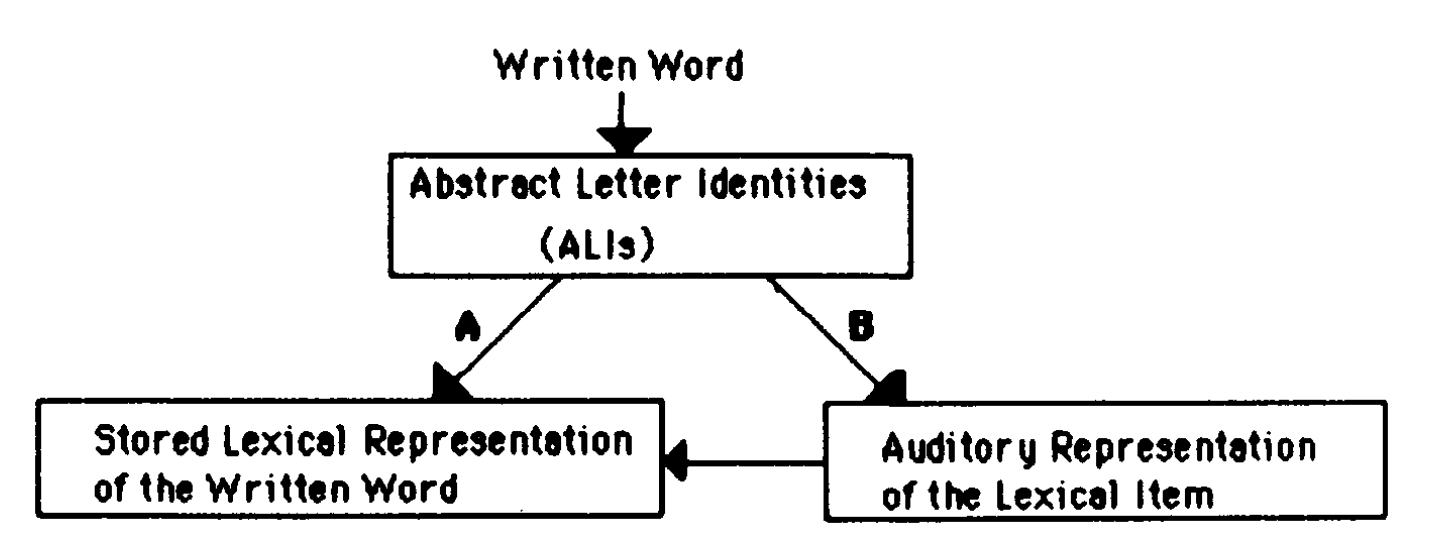
The two reading routes (Fig 14-1)
Recognise the word as a whole from its written form → its stored lexical representation. Essential for irregular words (yacht, colonel).
Compute the word's sound from its orthography (by GPC), then access the word from that sound. Available for regular words and pronounceable non-words.
Both routes are possible in an alphabetic language — but that both are possible does not prove both are used. (See the diagram in The Reading Models tab.) The chapter weighs the evidence from normal readers below.
Three theories of the spelling–sound units: graphemes, each → its most common phoneme (Coltheart); syllables (Hansen & Rodgers 1968); any orthographic unit (Marcel 1980).
Does normal reading actually use the phonological route?
Early connectionists (Wernicke, Lichtheim, Dejerine 1892; later Geschwind) assumed reading is mostly phonologically mediated. The evidence centres on the regularity effect. Click each to reveal:
Regular words are read aloud faster than irregular ones (Baron & Strawson 1976; Coltheart et al. 1979). Gough & Cosky showed the advantage vanishes if the spoken response is delayed → regular words are recognised faster, not merely easier to pronounce.
Coltheart (1978) objected that reading aloud also involves speaking, and favoured the lexical-decision task (is this string a word?). There, regularity affects only the rejection of non-words: the reliable pseudo-homophone effect — items like burd, blud are slow to reject (Rubenstein et al. 1971) because they're converted to sound and sound like words. But regularity does not speed real-word recognition.
Seidenberg et al. (1984): the regularity effect is confined to low-frequency words. And lexical analogies matter — a regular word like gave has an inconsistent neighbour (have), and such "regular inconsistent" words behave irregularly (Glushko 1979; Bauer & Stanovich 1980), modelled by McClelland & Rumelhart's (1981) interactive-activation account (mint activates pint).
The model we started with — that reading requires converting orthography to sound — is wrong. Spelling-to-sound conversion is possible, but its role is very limited (mainly low-frequency words). Most reading uses the fast direct, whole-word route simply because it is faster.
The Four Acquired Dyslexias
The modern, psycholinguistic study began with Marshall & Newcombe (1973). Each syndrome impairs a different part of the dual-route model — the contrasts are exactly what reveal the architecture. Click a syndrome to study it:
Click a syndrome on the left.
Surface dyslexia fails on irregular words (the whole-word route is lost, so pint → "hint"). ↔ Phonological alexia fails on non-words (the phonological route is lost).
This double dissociation is the strongest single argument that the lexical and non-lexical routes are independent — no single-route model can explain both.
Both abolish non-word reading. They differ only in the presence/absence of semantic paralexias: deep dyslexia HAS them (so it = phonological-route loss plus a lexical-semantic deficit), phonological alexia does NOT. A single syndrome can reflect several impairments at once.
The Reading Models
The three figures are a progression — from the basic two-route model, through the early deep-dyslexia model, to the revised model the syndromes force on us. Click a model to study it:
Click a model above.
How the four syndromes map onto the model
| Syndrome | What's impaired | How it reads |
|---|---|---|
| Surface dyslexia | the direct / whole-word route (A) | via the phonological route in isolation → regularization errors |
| Phonological alexia | the non-lexical / phonological route (D) | via the lexical route → can't read non-words, but no paralexias |
| Deep dyslexia | the phonological route + the semantic link | forced onto the "unstable" semantic route → semantic paralexias |
| Semantic / "Alzheimer" | the semantic store (route bypasses it) | A-B-C runs to speech without activating meaning |
Cheatsheet
Everything condensed. The whole chapter hangs on one move: orthography → two routes → the dyslexias dissociate those routes.
Orthography spectrum
| Type | Representation | Examples |
|---|---|---|
| Transparent alphabetic | 1 grapheme ↔ 1 phoneme both ways | Italian, Serbo-Croatian |
| Alphabetic asymmetric | 1→1 print→sound; 1→many sound→spelling | French |
| Alphabetic opaque | many-to-many + context-dependent | English |
| Consonantal | vowels not written | Hebrew, Arabic |
| Syllabary | one sign per syllable | Kannada |
| Ideographic | symbol → whole word; no sounding-out | Chinese, Kanji |
The two routes
| Route | Path | Suited to |
|---|---|---|
| A — direct / whole-word / lexical | Written word → ALIs → stored lexical representation | words as wholes, incl. irregular words |
| B — phonologically mediated / indirect | Written word → ALIs → sound → lexical item (GPC) | regular words & pronounceable non-words |
Conclusion from normal readers: the direct route dominates; phonological mediation is limited (mainly low-frequency words). Evidence: the regularity effect (low-frequency only; Gough & Cosky show faster recognition); no real-word regularity effect in lexical decision; the pseudo-homophone effect (burd/blud); lexical analogies (gave/have).
The four dyslexias
| Syndrome | Hallmark | Impaired route / locus | Source |
|---|---|---|---|
| Surface | regularization errors (pint = "hint"); accepts pseudo-homophones | direct/whole-word route lost; phonological route in isolation | Marshall & Newcombe 1973; Coltheart 1985 |
| Deep | semantic paralexias (close → "shut") | phonological route lost + a lexical-semantic deficit | Marshall & Newcombe 1973; Coltheart 1980 |
| Phonological alexia | can't read non-words, but NO semantic paralexias | non-lexical (phonological) route lost; lexical route spared | Beauvois & Derouesne 1979 |
| Semantic / "Alzheimer" | reads irregular words aloud without their meaning | direct route → output bypassing semantics | Schwartz et al. 1979 |
Deep dyslexia — the full symptom cluster
| Semantic paralexia (hallmark) | display → "act"; close → "shut"; Krushchev → "Eisenhower" |
| Derivational paralexia | wisdom → "wise"; truth → "true" |
| Visual errors | stock → "shock" |
| Part-of-speech effect | nouns read better than adjectives & verbs |
| Concreteness effect | concrete (yellow) easier than abstract (honest) |
| Function words & non-words | very hard / impossible (the, which, if; bote, kald) |
Surface dyslexia fails irregular words (whole-word route) ↔ phonological alexia fails non-words (phonological route). The strongest single argument that the two routes are independent. Phonological alexia's existence proves two routes (Funnell's WB rules out Marcel's single-process model), and shows deep dyslexia needs an extra semantic deficit.
Names, dates & glossary
| Dejerine 1892 | alexia without agraphia (disconnection) vs alexia with agraphia (GPC store, left angular gyrus). (Ch.5) |
| Marshall & Newcombe 1973 | founded the psycholinguistic approach; named surface vs deep dyslexia. |
| Coltheart 1978/80/85 | lexical-decision evidence; Deep Dyslexia; the 3-step phonological route; the dual-route argument. |
| Beauvois & Derouesne 1979 | phonological alexia — proof of separable lexical & non-lexical routes. |
| Schwartz et al. 1979 | reading irregular words without semantics (Alzheimer case). |
| Seidenberg et al. 1984; Glushko 1979 | regularity confined to low-frequency words; lexical analogies. |
| Grapheme / GPC | a letter-group representing a sound / grapheme–phoneme conversion rules. |
| Pre-lexical phonology | recovering a word's sound from spelling before the word is recognised. |
| Regularization error | giving an irregular grapheme its commonest value (pint → "hint"). Hallmark of surface dyslexia. |
| Semantic paralexia | reading a word as one related in meaning (close → "shut"). Hallmark of deep dyslexia. |
| Pseudo-homophone | a non-word that sounds like a real word (burd, blud); slow to reject in lexical decision. |
| Lexical analogy | recognising a string by analogy with similarly-spelled words (have affects gave). |
| Logogen | a lexical recognition/production unit (Visual Input Logogen; Output Logogen). |
| ALIs | Abstract Letter Identities — the abstract letter codes computed from a written word. |
Orthographies range from transparent alphabetic (Italian) through opaque English to ideographic Chinese, and only sound-based scripts allow pre-lexical phonology. Reading therefore has two routes (Fig 14-1): a fast direct/whole-word route and a slower phonologically mediated one — and the evidence (regularity effects, pseudo-homophones, lexical analogies) shows the direct route dominates. The acquired dyslexias map onto this model: surface dyslexia loses the whole-word route (regularization errors), deep dyslexia loses the phonological route and adds a semantic deficit (semantic paralexias), phonological alexia loses only the non-lexical route (no non-words, no semantic errors), and Schwartz et al.'s case reads irregular words without meaning. The surface ↔ phonological alexia double dissociation is the strongest argument that reading is organised into separable routes (Fig 14-3).
Active-Recall Self-Test
Don't re-read — retrieve. Answer each out loud (or on paper), then click to reveal. ★ = high-yield.