From words to sentences — and how the sentence breaks down
Chapters 12–14 dealt with disorders of single words. Chapters 15–16 move up to the sentence — its form (production, here) and its meaning (comprehension, Ch.16). Following the method of Part III, Caplan does not survey every study but takes one symptom in depth: expressive agrammatism — first building the normal apparatus (vocabulary classes, word order, a production model), then using it to dissect the disorder.
Agrammatism is the telegraphic speech of Broca's aphasia: function words and affixes are omitted while content words survive. Located in Garrett's model of sentence production, the deficit sits at the positional level (the syntactic frame) — while the functional level (thematic roles) stays intact. That single line is the high-value exam point.
The core symptom, in one example
Asked about his week, an agrammatic patient produces: "…ah … Monday … Dad and P.H. and Dad … hospital. Two … doctors …, and ah … thirty minutes … and yes … hospital." The content words (nouns, days, numbers) are there; the function words and grammatical endings that would knit them into sentences are gone. The speech is effortful, non-fluent, telegraphic.
Agrammatism is a symptom (classically of Broca's aphasia), not a whole syndrome — and its very status as a single category is disputed (Badecker & Caramazza 1985). Always pair the symptom description with where it sits in the model; don't just list features.
"Disturbances of sentence production" is the recurring question for this chapter — set in 2024 (Q3/Q5 alternative). Its sibling, "disturbances of sentence comprehension" (2025 Q5 alt), belongs to Ch.16. Two further high-value items: agrammatism vs paragrammatism, and Garrett's model. The mapping that scores: lead with the symptom → locate it in Garrett's model → conclude "positional-level deficit, functional level intact."
→ Start with the Building Blocks, build up Garrett's Model, dissect Agrammatism, consolidate in the Cheatsheet, and prove it in the Self-Test.
Building Blocks: Vocabulary Classes & Word Order
Before the disorder, the normal materials. As Hughlings Jackson (1874) noted, words combine into larger structures carrying meaning beyond the individual items — phrasal and sentential meaning. Agrammatism strikes precisely one slice of the vocabulary, so the first question — "what exactly is lost?" — is really a question about how to define these classes.
Meaning beyond the word
Four kinds of meaning are conveyed by groups of words, not single ones:
| Feature | What it encodes |
|---|---|
| Thematic roles | who did what to whom — agent, theme, recipient, instrument |
| Attribution / modification | which qualities attach to which items |
| Scope of quantification | what falls under quantifiers — negatives, numerals |
| Co-reference | which nouns, pronouns & reflexives pick out the same real-world thing |
Combining words into such structures is rule-governed — the project of modern syntax since Chomsky's Syntactic Structures (1957).
1 · Content words vs function words
Nouns, adjectives, verbs, many adverbs (and perhaps some prepositions). They refer to objects, actions, attributes. New ones can always be coined → an open class.
Articles, pronouns, auxiliaries, many prepositions, possessives. They create syntactic structure (relative clauses, complements, questions) and a few semantic notions (possessive, future).
Our intuition that they differ is right but hard to pin down by syntax or semantics alone. "Function words are more abstract" fails: the preposition under is concrete, while the content word honesty is abstract (and unicorn has no real referent). Three other criteria draw the line cleanly:
| Criterion | How it separates the two classes |
|---|---|
| Phonological | Function words never bear the main stress of a normally intoned sentence; only content words can. (Function words are "phonological clitics.") |
| Word-formation | Function words do not enter freely into compounding; content words form greenhouse, cutthroat freely (a productive process). Function-word compounds are rare & frozen (he-man, runoff). |
| Psychological | Function words are a CLOSED CLASS — a fixed set (~500 in English) whose members are extremely frequent (most of the 100 commonest English words). Once learned, no more are added. |
2 · A third class — affixes
Affixes ("morphological items": -ed, -ing, -s, -tion) are not words at all — they are attached during word-formation. They split two ways:
| Split | Type A | Type B |
|---|---|---|
| By syntax | Derivational — can change category; independent of sentence form (destroy → destruction → destructive) | Inflectional — never change category; depend on sentence structure ("late & local" agreement: he destroys) |
| By phonology | Word-boundary — leave the stem's sound intact (-ly, -ment, -ness; all inflections; Anglo-Saxon) | Formative-boundary — alter the stem's sound (-ive, -tion; Latinate: destroy → destruction) |
English stacks affixes in a strict order. Derivational before inflectional: horrifies is fine (noun horror → verb horrify → +s), but *considersation is not (you can't make a noun out of the already-inflected considers). And formative-boundary before word-boundary: receptiveness (-ive then -ness) and homelessness (-less then -ness) are legal, but *homelessity is not (a formative-boundary affix cannot follow a word-boundary one). Order: formative-boundary derivational → word-boundary derivational → word-boundary inflectional.
Why it matters for the exam: this is the basis of the testable prediction that separates the two accounts of agrammatism (see the Agrammatism tab) — the linguistic accounts predict formative-boundary affixes are retained, the psychological account does not distinguish them.
3 · Word order & thematic roles
Languages have a canonical word order: English is SVO, Japanese SOV (German is SVO in main clauses, SOV in subordinate ones). In simple actives, the linear order of major categories — N-V-N — maps quite directly onto thematic roles:
"The boy pushed the girl" — the bare sequence noun–verb–noun already signals boy = agent, girl = theme. Deviations from canonical order (the passive, topicalisation — "Salami, Seymour doesn't like", object relativisation, question inversion) are where function words and inflectional markers do their most visible work.
Many sentences can be processed on a superficial analysis — little more than a sequence of major categories. This is the crux later: agrammatic patients lean heavily on canonical N-V-N order, and the fact that they still use it (Caplan 1983) is the evidence that their thematic-role system — Garrett's functional level — is intact.
Garrett's Model of Sentence Production
To locate a production deficit you first need a model of normal production. Garrett (1976, 1982, 1984) built one from a corpus of several thousand naturally occurring speech errors, on a simple principle: if two elements interact in an error, they are active at the same processing stage; if two kinds of element never interact, they are handled at different stages.
Four revealing error types
| Error type | Example | Constraints | Arises at |
|---|---|---|---|
| Semantic substitution | boy for girl; black for white | content words (+ certain prepositions) only | Functional |
| Word exchange | "planting the garden in the flowers" | content words, same category, across phrases (never within one phrase) | Functional |
| Sound exchange | "shinking sips" (sinking ships) | content words, usually adjacent, within a phrase, across categories | Positional |
| Stranding | "he is schooling to go" (going to school) | the affix stays put; the content stem moves | Positional |
In "he is schooling to go," the suffix -ing stays in its slot while the stem go/school moves. The affix is left behind because it was already built into the frame — proof that function words and bound morphemes are part of the positional frame, not inserted with the content words. Worth quoting in an essay.
The five levels — click any box or brace
Fig 15-1 alternates processes (boxes) with the levels of representation (braces) they produce. Click an element on the figure — or a stage on the right — to study it. The two levels that matter for agrammatism are flagged.
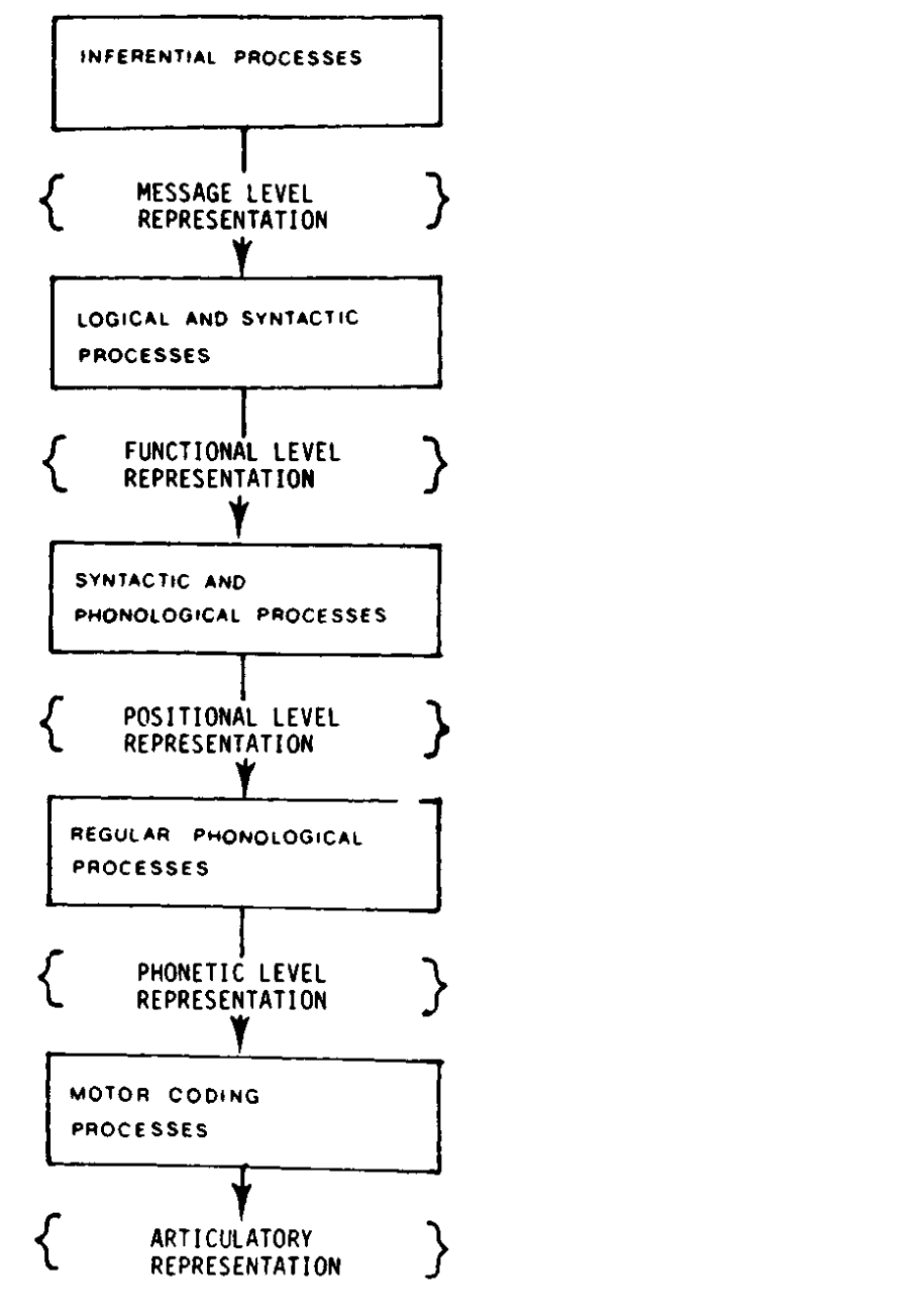
Click a box or brace on the figure, or a stage above.
Because function words & inflections are already in the positional frame (not inserted like content-word phonology), a single deficit in building the positional level could explain agrammatism at one stroke — both the omitted grammatical morphemes and the simplified syntax. The functional level above it (content words + thematic roles) is left intact. Hold this thought into the Agrammatism tab.
Garrett's model is deliberately under-specified: it does not fix the exact phonological form of words, ignores differences between morphological endings, and says little about how syntactic structures are built. Its strength is that it is grounded in empirical data (real speech errors) and is precise enough to serve as a reference model for studying breakdown.
Agrammatism
Now the disorder. With the vocabulary classes and Garrett's model in hand, we can ask the four questions that organise the research: what is lost? why does it vary? how does it differ from paragrammatism? and where in the model does it sit?
The symptom
In Broca's aphasia: the widespread omission of function words and affixes, with relative preservation of content words — in speech, and often in repetition and writing. The result is telegraphic, effortful, non-fluent.
What is lost? — two frameworks
Defining the affected class precisely is the central theoretical task, and two accounts compete:
| Framework | The affected class is… | Note |
|---|---|---|
| Psychological | the CLOSED CLASS — defined by its fixed number & high frequency | Would not separate word- from formative-boundary affixes (both are closed-class) |
| Linguistic (Kean 1977) | PHONOLOGICAL CLITICS — items that are not "phonological words" & bear no stress | Neatly unites free function words + bound inflectional affixes despite their different syntactic jobs |
Lapointe (1983) adds a morphological characterisation and disputes that Kean's (now superseded) phonological theory is the right framework. The accounts largely overlap, but differ on a testable point: the linguistic accounts predict formative-boundary affixes are retained while word-boundary affixes are omitted; the psychological account makes no such distinction.
Why does it vary? — the "case against agrammatism"
Detailed study shows agrammatism varies greatly from patient to patient (Goodglass 1973; Luria 1973; Miceli et al. 1983). Badecker & Caramazza (1985) collected speech samples — all labelled "agrammatic" — that differ widely (Table 15-1), and argued the category is so internally variable it should be abolished, and cannot be cleanly separated from paragrammatism. Click each pattern:
"…ah … Monday … Dad and P.H. and Dad … hospital. Two … doctors …, and ah … thirty minutes …" — the classic telegraphic profile.
"The young … the girl … the little girl is … the flower"; "The girl is … going to flowers." The verb itself is missing.
"The girl is flower the woman"; "The man kodaks … the girl." A noun is pressed into service as a verb.
"The painter washed the paint…"; "The cat leans the sofa up…" The thematic/semantic relations are wrong.
Caplan's reply — much variation is principled
The situation is not as bad as Badecker & Caramazza claim. Several principled distinctions absorb much of the variation:
Verbs are excluded from every linguistic characterisation of the affected class. So verb omission / nominalisation is a form of anomia for verbs (Miceli et al. 1984) — a separate symptom, not part of agrammatism. Patterns (B) and (C) above therefore drop out.
Three further sources of variation are expected, not embarrassing:
- Inter-language differences — e.g. Italian verb roots are not real words, so they require inflection (Kean: agrammatics are constrained to produce real words).
- Severity — a mildly agrammatic patient inflects correctly; a severe one omits even plural agreements (and can't omit verb agreements if no verbs are produced).
- Complexity within the class — some items are intrinsically more "omission-prone" (below).
Goodglass & Berko (1960) — the -s study
The suffix -s marks the plural, the 3rd-person-singular present, and the possessive. Its sound also varies: unvoiced /s/ (hits, cups), voiced /z/ (runs, ties), and syllabic /əz/ (watches, churches). Findings:
- The possessive & 3rd-singular are omitted more than the plural (3rd-sg ≈ possessive) — a universal hierarchy of difficulty (Goodglass 1973), the same in fluent and non-fluent patients.
- The syllabic /əz/ form (churches) survives better than /s/ or /z/ — because it is more sonorant (the sonorance hierarchy from Ch.13). The same linguistically-defined class is omitted unequally for principled phonological reasons.
Goodglass's "salience"
The "psychological resultant of stress, of the informational significance, of the phonological prominence, and of the affective value of a word" (Goodglass 1973: 204). Low-salience function words are the most vulnerable to omission; stressing an item (even a complex one) makes it easier to produce. It is not a purely linguistic concept — like "phrase length," it is defined over linguistic material but not within formal theory — which is why the "slightly older" and "slightly newer" psycholinguistic schools (Ch.11) disagree on whether such a construct is legitimate.
MM omitted only certain French function words (the weak pronouns le, la, lui — not the strong il, elle, moi, toi) and auxiliaries, and only in sentences (he read them perfectly in isolation). When Nespoulous highlighted those words with a rose marker, MM read them — but began omitting other function words; highlight those too, and yet others dropped. He never omitted content words. Moral: an apparently restricted deficit was really a broad, "higher-order" impairment of the whole function-word class, manifesting subtly.
Agrammatism vs paragrammatism (Grodzinsky 1984)
| Agrammatism | Paragrammatism | |
|---|---|---|
| Fluency | non-fluent, effortful | fluent |
| Syndrome | Broca's aphasia | Wernicke's aphasia |
| What happens to grammatical elements | omitted | substituted / mis-selected |
In Hebrew, inflectional vowels are interpolated into consonantal roots (root y-l-d → yeled, yalda, yiladim), so pure omission would leave roots unpronounceable. Grodzinsky's agrammatic patients therefore omitted free-standing function words but substituted vowel morphology — agrammatic and paragrammatic at once. His conclusion: the two syndromes share the same linguistic locus and the same basic disturbance — mis-selection within a morphological paradigm — and differ only by one constraint: agrammatism adds a preference for the phonologically null member of each paradigm (perhaps tied to a co-occurring motor-speech disturbance), which paragrammatism lacks.
Where does it strike? — converging on the positional level
Is the omission of function words tied to wider syntactic problems? Pick (1913) first asked; the answer is yes. Goodglass et al. (1972) found virtually no well-formed utterances in an agrammatic's speech; Caplan (1985) proposed (perhaps too strongly) that agrammatics build no phrasal nodes (NP, VP), encoding meaning only through linear major-category sequences. All agrammatics show some impoverishment of syntax, and all fail to produce embedded verbs at normal rates. Because Garrett (1982) builds the syntactic frame at the very stage where function words are accessed, a single positional-level deficit explains both the omissions and the simplified syntax.
Saffran et al. found an animacy effect on the order of nouns around verbs (animate nouns tend to come first) and concluded that agrammatics had lost thematic roles — a more "profound" deficit, separate from the function-word problem.
Caplan (1983) re-analysed the data with three additive rules that fit every cell while assuming thematic roles are intact: (1) produce the active voice; (2) put animate nouns before the verb; (3) put agents / instruments before the verb. (The animate-agent/animate-theme 2:1 ratio falls straight out of rules 2+3 reinforcing, vs rule 2 alone.)
So agrammatics keep thematic roles and canonical N-V-N order — they have merely added an animacy principle. This confirms Garrett's prediction exactly: functional level intact, positional level impaired.
Beyond production — a central deficit?
The disturbance may not be confined to speech.
Given three words from a sentence and asked which two are most closely related, normals group syntactically-related words; agrammatics group the major lexical items on a semantic basis and omit the function words entirely. The function-word disturbance shows up even when no speaking is required → a "central" disturbance of the function-word system.
Agrammatics fail to interpret sentences whose meaning requires genuine syntactic analysis (e.g. reversible passives) — "asyntactic comprehension" (also Heilman & Scholes 1976; Schwartz et al. 1980b). The deficit affects the construction of syntactic structure whatever the task. But the link is not universal — some agrammatics comprehend normally (taken up in Ch.16).
Bradley: in normals, reaction time falls with frequency for open-class words but shows no frequency effect for closed-class words (and only open-class words produce a non-word interference effect) → closed-class words have a special recognition routine (frequency-insensitive, not left-to-right). Agrammatics show the frequency effect for both classes → they are forced to use the open-class routine for closed-class items, underlying their problems. Gordon & Caramazza: with non-linear regression the classes behave alike, and a replication found no difference beyond generally slower RTs → failed to replicate a special closed-class access deficit.
Cheatsheet
Everything condensed. The whole chapter hangs on one move: vocabulary classes → Garrett's levels → agrammatism is a positional-level deficit, the functional level intact.
The three vocabulary distinctions
| Distinction | How the line is drawn |
|---|---|
| Content vs function words | by stress (function words never bear it), compounding (function words don't), & the closed class (~500, very frequent) |
| Derivational vs inflectional affix | derivational changes category & is sentence-independent (destruction); inflectional doesn't & is sentence-dependent (destroys) |
| Word- vs formative-boundary affix | word-boundary leaves the stem's sound intact (-ness, all inflections); formative-boundary alters it (-ive, -tion) |
Garrett's levels — and where agrammatism strikes
| Level | What is specified there | Errors / status |
|---|---|---|
| Message | pre-linguistic concepts (inferential processes) | — |
| Functional | content-word lexical items + thematic roles / verb argument structure — meaning, not yet sentence form | word substitutions & exchanges · INTACT |
| Positional | the syntactic frame, already holding function words & inflections; content-word phonology slotted in | sound exchanges & stranding · IMPAIRED |
| Phonetic | detailed phonological form (regular phonological processes) | — |
| Articulatory | motor commands to the vocal apparatus | — |
Stranding (affix left, stem moves) is the key evidence that grammatical morphemes live in the positional frame. So one positional-level deficit → both the omissions and the syntactic simplification.
The four debates
| Issue | The contrast |
|---|---|
| Defining the lost class | Psychological (closed class) vs linguistic (Kean: phonological clitics; Lapointe: morphological) |
| One syndrome or many? | Badecker & Caramazza (1985): abolish it (too variable) · Caplan: much variation is principled (verb anomia, language, severity, sonorance, salience) |
| vs paragrammatism | Grodzinsky (1984): same locus & basic mis-selection; agrammatism adds a preference for the null element |
| Thematic roles | Saffran et al. (1980): lost · Caplan (1983): intact (3 additive rules; animacy added, roles preserved) |
Agrammatism vs paragrammatism
| Agrammatism | Paragrammatism | |
|---|---|---|
| Fluency / syndrome | non-fluent · Broca's | fluent · Wernicke's |
| Grammatical elements | omitted | substituted |
| Grodzinsky's verdict | same locus + same disturbance (mis-selection in a paradigm); agrammatism adds the null-element preference | |
Key studies
| Garrett (1976/82/84) | speech-error model: message / functional / positional / phonetic / articulatory levels |
| Kean (1977) | the affected class = phonological clitics |
| Goodglass & Berko (1960); Goodglass (1973) | unequal -s omission (poss. & 3rd-sg > plural); hierarchy of difficulty; salience |
| Badecker & Caramazza (1985) | the heterogeneity critique — "the case against agrammatism" |
| Grodzinsky (1984) | Hebrew vowel-tier; agrammatism & paragrammatism share a locus |
| Saffran et al. (1980) / Caplan (1983) | the "word-order problem": lost thematic roles vs intact (animacy added) |
| Zurif et al. (1972); Caramazza & Zurif (1976) | a central function-word/syntactic deficit → asyntactic comprehension |
| Bradley et al. (1980); Gordon & Caramazza (1982) | closed-class lexical-access hypothesis — and its failed replication |
Glossary
| Agrammatism | telegraphic speech (Broca's): omission of function words & affixes, content words spared |
| Paragrammatism | fluent disorder (Wernicke's): substitution / mis-selection of function words & affixes |
| Closed class | the fixed, highly frequent function-word set (~500) — the psychological definition of the lost items |
| Phonological clitic (Kean) | an element that is not a "phonological word" & bears no stress — the linguistic definition |
| Thematic roles / argument structure | who did what to whom (agent, theme…) / the roles a verb takes — specified at the functional level |
| Canonical word order | a language's basic order (English SVO); N-V-N → agent-action-theme in simple actives |
| Functional level | Garrett's stage: content words + thematic roles — intact in agrammatism |
| Positional level | Garrett's stage: the syntactic frame with function words/inflections — impaired |
| Salience (Goodglass) | stress + informational significance + phonological prominence + affective value — predicts what is omitted |
| Asyntactic comprehension | failure to understand sentences whose meaning requires genuine syntactic analysis |
Agrammatism is the telegraphic speech of Broca's aphasia: function words and affixes are omitted while content words survive. Defining the lost class is contested — psychologically it is the closed class, linguistically the phonological clitics (Kean 1977). Garrett's speech-error model gives the framework: a functional level (content words + thematic roles) feeds a positional level (the syntactic frame, already holding function words & inflections). The evidence converges on a positional-level deficit: agrammatics keep thematic roles and N-V-N order (Caplan 1983, against Saffran et al. 1980) but omit grammatical morphemes and simplify syntax together (Garrett 1982). Apparent heterogeneity (Badecker & Caramazza 1985) is largely principled — excluding verb anomia, and invoking severity, sonorance & salience — and agrammatism shares its locus with paragrammatism (Grodzinsky 1984), differing only by a preference for null elements. The deficit may extend to comprehension (asyntactic comprehension), taken up in Chapter 16.
Lead question — "Disturbances of sentence production" (2024, Q3/Q5 alt, recurring). Structure: symptom → Garrett's model → "positional-level deficit, functional level intact." Mention Badecker & Caramazza to show you know the category is debated; quote the stranding error.
Sibling — "Disturbances of sentence comprehension" (2025, Q5 alt) → Chapter 16 (asyntactic comprehension; note the production/comprehension link is not universal).
Also high-value: "Differentiate agrammatism & paragrammatism" (tabulate + Grodzinsky's shared-locus point + the Hebrew vowel-tier example), and "Garrett's model of sentence production" (name the four error types, tie each to a level, end on the positional-level conclusion).
Active-Recall Self-Test
Don't re-read — retrieve. Answer each out loud (or on paper), then click to reveal. ★ = high-yield.